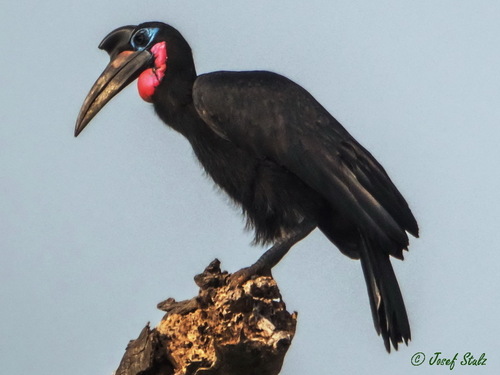
Abyssinian Ground Hornbill
Bucorvus abyssinicus
A prehistoric-looking giant of the African savanna, the Abyssinian Ground Hornbill is a master of the grasslands. With its vivid facial colors and pick-axe beak, this terrestrial titan is a fascinating subject for any backyard or trail camera enthusiast.
Quick Identification
Size
Height: 90 to 110 cm (35-43 in); Wingspan: 122 to 183 cm (48-72 in); Weight: 3 to 4 kg (6.6-8.8 lbs)
Colors
Matte black plumage with white primary feathers (visible in flight). Males have red and blue bare throat skin; females have entirely blue throat skin.
Key Features
- Distinctive open-fronted black casque on top of the bill
- Vivid blue and red facial skin surrounding the eyes and throat
- Long, thick eyelashes that protect eyes from savanna dust
- Stately, terrestrial walking gait on long, sturdy legs
When You’ll See Them
Geographic range
Where Does the Abyssinian Ground Hornbill Live?
This striking bird is native to the northern belt of Sub-Saharan Africa, stretching in a broad band from the Atlantic coast of Senegal and The Gambia eastward to the highlands of Ethiopia and Eritrea. It is a specialist of the Sahel and Sudanian savannas, thriving in the vast, open landscapes found in countries like Nigeria, Chad, and Sudan. While its range is expansive, the species is increasingly confined to protected areas and remote regions where large nesting trees and abundant prey remain undisturbed.
Basemap © OpenStreetMap contributors
Behavior
The Abyssinian Ground Hornbill is a highly intelligent and primarily terrestrial bird, spending about 70% of its day walking across the savanna in search of food. Unlike most hornbills, they are reluctant flyers, usually only taking to the air when threatened or to reach their nesting sites in large tree hollows or rocky crevices. They live in territorial pairs or small family groups, often using their deep, booming vocalizations—which sound like rhythmic drumming—to communicate across vast distances at dawn.
These birds are remarkably bold and curious. In areas where they coexist with humans, they may approach settlements to investigate shiny surfaces or scavenge for scraps. However, they are also formidable predators; they use their powerful, pick-axe-like bills to strike and subdue a wide variety of prey, ranging from large insects to venomous snakes. Their social structure is complex, with younger birds often staying with their parents for several years to assist in raising new chicks.
EverydayEarth exclusive
Camera Tips
To capture the Abyssinian Ground Hornbill on camera, ground-level placement is essential. These birds spend the majority of their time walking, so mounting your camera on a low post or even a sturdy ground stake about 1 to 2 feet (30-60 cm) off the ground will provide the most intimate, eye-level perspective. Angle the camera slightly upward to account for their impressive height, as they can stand nearly 4 feet tall. Because they are territorial and patrol the same routes daily, look for 'game trails' through tall grass or clearings near large, isolated baobab or acacia trees where they might nest.
While we don't recommend artificial baiting that could disrupt their natural diet, you can increase your chances by placing the camera near water sources during the dry season or in areas with high grasshopper activity. These hornbills are attracted to 'micro-habitats' like large logs or rock piles where they frequently probe for lizards and insects. Ensure your camera has a wide-angle lens and a fast trigger speed, as their stride is long and they can move across the frame surprisingly quickly when hunting.
Timing is everything with this species. They are most active in the cooler hours of the early morning and late afternoon. Set your camera to take multi-shot bursts or short video clips (15-20 seconds) to capture their unique foraging behaviors, such as the way they toss prey into the air before swallowing. If your camera allows, prioritize the highest possible resolution during the day, as their matte black feathers and vibrant facial skin require good lighting and detail to distinguish properly against the bright savanna backdrop.
Similar Species
Species that look similar or are commonly confused with Abyssinian Ground Hornbill.
Frequently Asked Questions
Record Abyssinian Ground Hornbill at your habitat
Connect a camera to start building your own species record — AI identifies every visitor automatically.