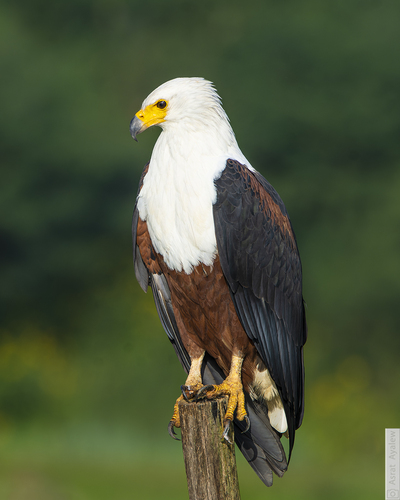
African Fish-Eagle
Icthyophaga vocifer
Known as the iconic 'Voice of Africa,' the African Fish-Eagle is a master of the skies and the water. With its striking white head and chestnut body, this majestic raptor is a symbol of the continent's wild river systems and Great Lakes.
Quick Identification
Size
Length: 63–75 cm (25–30 in); Wingspan: 2–2.4 m (6.6–7.9 ft); Weight: 2–3.6 kg (4.4–7.9 lb)
Colors
Pure white head, neck, and breast; dark chestnut-brown body and wing coverts; black flight feathers; white tail; yellow facial skin and feet
Key Features
- Bright white head and chest contrasting with chestnut body
- Broad, black wings held in a 'V' during soar
- Loud, yodeling call often delivered with head thrown back
- Distinctive yellow cere and unfeathered legs
When You’ll See Them
Sightings on EverydayEarth
Aug 1, 2026
A group of hippopotamuses is resting in the river, occasionally surfacing to breathe. On the far bank, two reticulated giraffes walk across the dry, brushy hillside. Several water birds are present, including an African fish-eagle perched on a mid-river rock and multiple Egyptian geese standing on the banks and rocks.
Jul 26, 2026
An African Fish-Eagle is perched prominently on a weathered, dead branch. It repeatedly throws its head back to emit its iconic, ringing call while scanning the surrounding woodland environment.
Jul 24, 2026
An adult African Fish-Eagle is perched on a large, dead branch. It spends the first several seconds meticulously preening its wing feathers with its beak before turning its head to scan the surrounding woodland area.
Jul 24, 2026
An African Fish-Eagle is perched on a weathered, dead branch overlooking the landscape. It is actively preening its feathers, turning its head to reach its chest and the undersides of its wings with its beak.
Jun 23, 2026
An adult African Fish-Eagle is perched atop a bare branch, surveying the landscape. It remains mostly still, turning its head occasionally to scan the surrounding woodland area.
Jun 23, 2026
An African Fish Eagle is perched on a dead tree limb, looking out over the landscape. It remains mostly still, scanning its surroundings with occasional sharp turns of its head to the side.
Geographic range
Where Does the African Fish-Eagle Live?
Native to the African continent, the African Fish-Eagle is found throughout sub-Saharan Africa wherever there is sufficient open water and a steady supply of fish. Its core range extends from the wetlands of Ethiopia and the Great Lakes of East Africa down to the river systems of South Africa and the Okavango Delta in Botswana. While they are absent from the most arid desert regions of Namibia and the Sahara, they are a common sight in almost every country south of the Sahel, making them one of the most widely distributed large raptors on the continent.
Basemap © OpenStreetMap contributors
Behavior
The African Fish-Eagle is often called the 'Voice of Africa' due to its evocative, haunting yodel. These birds are highly territorial and usually live in monogamous pairs. They spend a significant portion of their day perched on high branches overlooking water, scanning for movement. While they are master fishers, they are also known for their patience, often sitting motionless for hours before making a spectacular, high-speed dive to snatch a meal from just below the water's surface.
Socially, they are quite vocal, using their calls to establish territory and communicate with their mates. Their interaction with humans is generally wary but tolerant; they have adapted well to human-made dams and reservoirs, often becoming a focal point for ecotourism. Despite their regal appearance, they are opportunistic 'kleptoparasites,' frequently harassing other waterbirds like Goliath Herons to steal their catch.
EverydayEarth exclusive
Camera Tips
To capture high-quality images of an African Fish-Eagle, placement is everything. These birds have favorite 'plucking posts'—usually a dead limb or a high, bare branch overlooking a body of water. Use your binoculars to identify which trees they frequent for scanning or eating, and mount your camera on a nearby trunk or a sturdy pole facing that branch. Because they are large birds, a wide-angle lens is better for nest monitoring, while a telephoto setup is required for capturing their dramatic fishing dives.
Since these eagles are most active during the cooler parts of the morning and late afternoon, ensure your camera is positioned to take advantage of the 'golden hour' light without pointing directly into the sun, which can cause lens flare or silhouette the bird. If you are setting up near a shoreline, a low-angle mount can provide a powerful, intimate perspective of the eagle as it swoops down. Fast shutter speeds (1/2000s or higher) are essential if your camera allows for manual overrides, as their strike speed is incredibly fast.
Avoid placing cameras too close to active nests, especially during the incubation period, as this can cause the parents to abandon the eggs. Instead, focus on high-traffic foraging zones or frequently used perches. While you can't easily 'bait' an eagle in a backyard setting, maintaining a healthy, fish-filled pond or living near a natural waterway is the best way to ensure they visit your camera's field of view. High-resolution video mode is highly recommended to capture their iconic head-flip calling behavior.
Similar Species
Species that look similar or are commonly confused with African Fish-Eagle.
Palm-nut Vulture
Smaller and mostly white with black wing patches; lacks the rich chestnut body color of the Fish-Eagle.
Bald Eagle
Found only in North America; has a dark brown body compared to the Fish-Eagle's bright chestnut feathers.
Osprey
Smaller and slimmer with a dark mask through the eye; lacks the pure white head and chest of the Fish-Eagle.
Frequently Asked Questions
Record African Fish-Eagle at your habitat
Connect a camera to start building your own species record — AI identifies every visitor automatically.