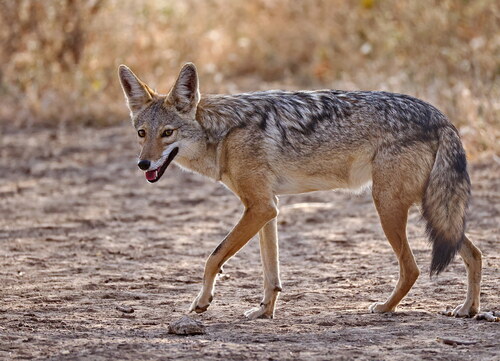
African Wolf
Canis lupaster
The African Wolf is a master of survival, roaming from the scorching Sahara to the rugged Atlas Mountains. This slender, vocal canid is a ghost of the Sahel, blending fox-like agility with the social intelligence of a wolf.
Quick Identification
Size
Length: 70–120 cm (28–47 in); Height: 40 cm (16 in) at the shoulder; Weight: 7–15 kg (15–33 lbs)
Colors
Sandy to yellowish-gray coat with darker variations on the back; white or pale fur on the throat, chest, and underparts; bushy tail often tipped with black.
Key Features
- Slender, long-legged build similar to a small wolf
- Large, pointed ears and a fox-like muzzle
- Dark dorsal stripe running along the spine
- Bushy, dark-tipped tail held low while running
When You’ll See Them
Geographic range
Where Does the African Wolf Live?
Native to the northern half of the African continent, the African Wolf occupies a massive range that stretches from the Atlantic coast of Senegal and Mauritania across the Sahel to the Horn of Africa. Its territory encompasses much of North Africa, including the Mediterranean regions of Morocco, Algeria, and Tunisia, as well as the highlands of Ethiopia. Unlike many other large carnivores, they have proven remarkably resilient to habitat changes, allowing them to maintain a presence across varied landscapes from sea level to high-mountain peaks.
Basemap © OpenStreetMap contributors
Behavior
The African Wolf is a resilient and highly adaptable canid that displays a complex social structure. They are primarily monogamous, forming pair bonds that can last for several years. Interestingly, their social groups often include 'helpers'—older offspring from previous litters that remain with the parents to assist in guarding and feeding the newest pups. This cooperative breeding strategy increases the survival rate of the litter and strengthens the pack's hold on their territory.
While they are capable predators, African Wolves are also opportunistic scavengers and foragers. They are territorial by nature, using scent marking and vocalizations to define their boundaries. In areas where they live close to human settlements, they have learned to navigate suburban edges and agricultural lands, often becoming more nocturnal to avoid direct conflict with people. Their vocalizations are a mix of high-pitched yips, barks, and mournful howls that are most frequently heard during the twilight hours.
EverydayEarth exclusive
Camera Tips
To capture the African Wolf on camera, placement is everything. These canids are extremely fond of using established paths; look for game trails that run along the edges of agricultural fields or dry riverbeds (wadis). Position your camera at a height of about 18 to 24 inches (roughly knee-high) to ensure the lens is level with their torso. Aim the camera at a 45-degree angle to the trail rather than perpendicular to it; this gives the trigger more time to fire as the animal approaches, reducing the chance of capturing just a tail or a blurry hindquarter.
In arid environments, water is the ultimate draw. If you have access to a permanent water hole or a leaky irrigation pipe in a rural or suburban edge, this is your best chance for a high-quality capture. African Wolves are naturally curious but cautious. While food baiting can work, it often attracts unwanted domestic dogs or pests. Instead, try using a 'scent station' with a non-food lure like fatty acid tablets or even a splash of pungent cologne on a nearby rock to encourage the wolf to stop and sniff, giving you a perfect still shot.
Because the African Wolf is most active during the crepuscular hours (dawn and dusk) and throughout the night in human-populated areas, ensure your camera has a high-quality infrared (IR) flash. Use a 'Burst Mode' or 'Multi-Shot' setting of 3-5 frames. These wolves move with a purposeful, steady trot, and a single photo might miss the best angle. If your camera supports it, high-definition video with audio can be incredibly rewarding, as you might capture their distinctive yapping or howling communication.
Similar Species
Species that look similar or are commonly confused with African Wolf.
Frequently Asked Questions
Record African Wolf at your habitat
Connect a camera to start building your own species record — AI identifies every visitor automatically.