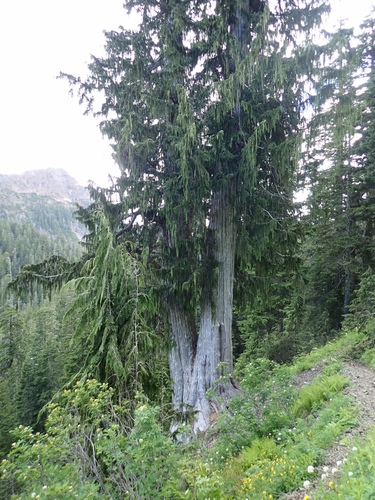
Alaska yellow cedar
Callitropsis nootkatensis
A majestic and resilient icon of the Pacific Northwest, the Alaska yellow cedar is famous for its elegant weeping branches and incredibly durable, aromatic yellow wood.
Quick Identification
Size
Typically reaches 20–40 m (65–130 ft) in height with a trunk diameter of up to 2 m (6.6 ft).
Colors
Dark green to bluish-green scale-like leaves; bark is grayish-brown, weathering to silver-gray; interior wood is a distinct sulfur-yellow.
Key Features
- Distinctive weeping or 'wilting' branchlets that hang vertically
- Gray-brown bark that peels off in long, thin vertical strips
- Small, round cones (8-12 mm) with 4-6 scales and a small point
- Foliage arranged in flat, pendulous sprays
When You’ll See Them
Geographic range
Where Does the Alaska yellow cedar Live?
Native to the Pacific coast of North America, the Alaska yellow cedar thrives in the cool, misty corridor stretching from the Prince William Sound in Alaska down through British Columbia. Its range extends southward into the Olympic Mountains of Washington and the Cascade Range of Oregon, with isolated populations found as far south as the Siskiyou Mountains in northern California. It is a specialist of the temperate rainforest, rarely found far from the influence of maritime moisture.
Basemap © OpenStreetMap contributors
Behavior
The Alaska yellow cedar is a remarkably slow-growing and long-lived species, with some individuals surviving for over 1,000 years. Unlike many faster-growing conifers, this tree invests heavily in its chemical defenses, producing a rot-resistant wood that smells faintly of raw potatoes or resin when cut. It is a shade-tolerant species, often found growing in the understory of old-growth forests before eventually reaching the canopy.
In its natural ecosystem, the tree plays a vital role in providing habitat for various wildlife. Its dense, weeping foliage offers excellent thermal cover for birds and small mammals during the harsh winters of the Pacific Northwest. While it doesn't 'behave' in the animal sense, it is currently at the center of an ecological mystery known as 'yellow cedar decline,' where thinning snowpacks cause its shallow roots to freeze, leading to widespread mortality in certain regions.
EverydayEarth exclusive
Camera Tips
When capturing the Alaska yellow cedar on a trail camera, your goal is to showcase its unique 'weeping' architecture. Place your camera at a wide angle and a distance of 10-15 feet to capture the full silhouette of the tree against the sky or forest backdrop. The drooping branches are its most photogenic feature, especially when heavy with rain or snow. To highlight the texture of the shredding bark, set a secondary camera closer to the trunk at chest height (about 4-5 feet) with high-contrast settings.
Because this tree is a magnet for forest birds like the Varied Thrush and various nuthatches, position your camera to overlook the mid-canopy branches if possible. If you are using an AI-powered camera in your backyard, placing it near the base of the tree can capture the many small mammals, such as Douglas squirrels, that frequent the tree for cover. The yellow cedar's foliage remains vibrant year-round, making it an excellent subject for time-lapse photography to document the changing light of the seasons.
For the best results, utilize the early morning or 'blue hour' light. The soft, diffused light of a cloudy Pacific Northwest day prevents the deep shadows that can obscure the intricate patterns of the scale-like leaves. If your camera has a macro mode or high-resolution sensor, try to get a shot of the small, spherical cones in late summer. During winter, ensure your camera is positioned to handle the high-contrast white of snow resting on the dark green boughs, perhaps by adjusting the exposure compensation slightly downward.
Similar Species
Species that look similar or are commonly confused with Alaska yellow cedar.
Frequently Asked Questions
Record Alaska yellow cedar at your habitat
Connect a camera to start building your own species record — AI identifies every visitor automatically.