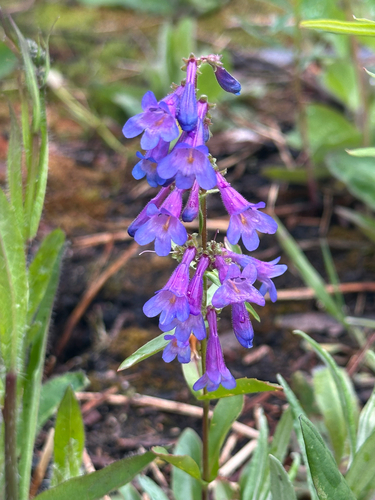
Alberta Beardtongue
Penstemon albertinus
A vibrant jewel of the Rocky Mountains, the Alberta Beardtongue dazzles with its brilliant sky-blue flowers. This hardy perennial is a favorite for high-altitude pollinators and a must-see for backyard mountain explorers.
Quick Identification
Size
Height: 10–40 cm (4–16 inches); Flowers: 1.5–2 cm (0.6–0.8 inches) long
Colors
Brilliant sky blue to deep violet-blue flowers; light green to blue-green foliage
Key Features
- Tubular blue flowers with two-lobed upper lips and three-lobed lower lips
- Opposite, lance-shaped leaves with smooth or slightly toothed edges
- Stems are hairless (glabrous) and often grow in clumps
- Golden-yellow hairs on the sterile stamen (the 'beardtongue')
When You’ll See Them
Geographic range
Where Does the Alberta Beardtongue Live?
The Alberta Beardtongue is a specialty of the Pacific Northwest and the Northern Rocky Mountain region of North America. It is natively found across southeastern British Columbia and southwestern Alberta, extending southward into the rugged mountains of Idaho, western Montana, and northeastern Washington. This species thrives in the montane and subalpine zones, rarely straying far from the rocky terrain of its namesake peaks.
Basemap © OpenStreetMap contributors
Behavior
Alberta Beardtongue is a hardy, clump-forming perennial that defines the rugged beauty of the northern Rocky Mountains. Unlike animals, its 'behavior' is dictated by the sun and the seasons. It emerges shortly after the snow melts, taking advantage of the spring moisture to produce its striking floral display. During the day, the flowers orient themselves toward the light, opening wide to invite a variety of specialized pollinators.
This species is a crucial player in its ecosystem, acting as a high-energy nectar source for native bees, butterflies, and hummingbirds. While it is generally resistant to light grazing, it has evolved to thrive in nutrient-poor, rocky soils where other plants struggle. To humans, it is a beloved sign of late spring in the mountains and a popular choice for xeric (water-wise) rock gardens due to its drought tolerance and vibrant color.
EverydayEarth exclusive
Camera Tips
Capturing the Alberta Beardtongue on camera is less about catching a fleeting moment and more about documenting a lifecycle. To get the best results, set your camera to a 'Time-Lapse' mode rather than 'Motion Trigger.' This allows you to capture the slow unfolding of the buds into brilliant blue blossoms over several days. If your camera has a macro or close-focus setting, place it within 18–24 inches of the flower spike to capture the fine golden hairs on the stamen that give the 'beardtongue' its name.
If you are interested in the wildlife that visits the plant, position your camera at a 45-degree downward angle about 3 feet away from a healthy cluster of blooms. Alberta Beardtongues are magnets for clearwing moths and bumblebees; setting your trigger interval to the shortest possible time (or using 'Burst' mode) will help you catch these fast-moving pollinators mid-sip. Early morning light provides the most saturated blue tones, as midday sun can wash out the delicate petal colors.
Be mindful of the wind, which is common in the rocky habitats where this species grows. High winds can cause 'false triggers' on PIR sensors if the plant is moving vigorously. To avoid a memory card full of swaying leaves, reduce your camera's sensitivity slightly or use a physical stake to subtly steady the main flowering stem if you are working in a backyard setting. In the wild, look for south-facing slopes where the plants bloom earliest in the season.
Frequently Asked Questions
Record Alberta Beardtongue at your habitat
Connect a camera to start building your own species record — AI identifies every visitor automatically.