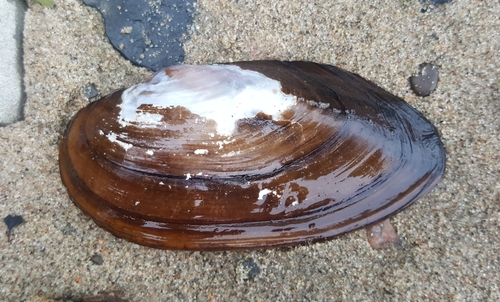
Alewife Floater
Utterbackiana implicata
A silent guardian of coastal waterways, the Alewife Floater is a master of filtration with a life cycle inextricably linked to the migration of Atlantic herring.
Quick Identification
Size
7.5 to 18 cm (3 to 7 inches) in length; typically weighs 100-300 grams depending on age and shell thickness.
Colors
Yellowish-tan, greenish, or brownish-black shell; younger specimens often show bright green rays; interior nacre is pearly white, bluish-white, or salmon-colored.
Key Features
- Elongate-ovate shell that is notably thickened at the front (anterior) end
- Absence of hinge teeth, resulting in a smooth interior hinge line
- Thin, fragile shell compared to other mussels, but sturdier than the Eastern Floater
When You’ll See Them
Geographic range
Where Does the Alewife Floater Live?
The Alewife Floater is native to the Atlantic drainage of North America, where its distribution is closely tied to the migratory paths of its host fish. Its core range spans from the Canadian Maritime provinces of New Brunswick and Nova Scotia southward along the United States eastern seaboard to South Carolina. It is primarily found in lowland coastal regions where rivers maintain a direct connection to the Atlantic Ocean.
Basemap © OpenStreetMap contributors
Behavior
The Alewife Floater is a sedentary freshwater mussel that spends most of its life partially buried in the substrate of coastal rivers and ponds. As a filter feeder, it plays a vital role in maintaining water clarity and quality by sifting out organic particles and bacteria. Unlike more mobile aquatic creatures, its movements are limited to slow, muscular 'crawling' using a fleshy foot to adjust its position in response to water levels or flow changes.
This species has a fascinating and complex reproductive strategy known as larval parasitism. To complete its life cycle, it releases tiny larvae called glochidia into the water, which must attach themselves to the gills or fins of a specific host fish—most commonly the Alewife (Alosa pseudoharengus). After hitchhiking for several weeks and developing into juveniles, they drop off the fish and settle into the riverbed to begin their adult lives. This unique dependency makes them highly sensitive to dams and barriers that block fish migration.
EverydayEarth exclusive
Camera Tips
Capturing the Alewife Floater on camera requires a specialized underwater approach since these bivalves are mostly submerged and stationary. The most effective method is using a waterproof action camera or an underwater trail camera placed in a clear, shallow section of a coastal stream or pond. Look for areas with sandy or silty bottoms where the edges of the shells might be poking out. Positioning the camera at a low angle, nearly level with the substrate, allows you to see the 'siphons'—the small openings the mussel uses to breathe and feed. On a clear day, you can often record the siphons pulsing as they filter water.
To capture 'action' related to these mussels, focus your camera on a 'midden' site on the bank. Muskrats, raccoons, and otters are the primary predators of the Alewife Floater and will often bring shells to a specific flat rock or log to eat. By aiming a standard trail camera at these shell piles, you can record the nocturnal mammals that rely on these mussels for food. This provides a fascinating secondary way to document the species' presence in your local environment without needing specialized underwater gear, and it highlights the mussel's role in the local food web.
If you are using an underwater setup, the best time to record is during the spring Alewife migration (March to May). During this time, the water is often clear, and you may capture the mussel's host fish swimming nearby, which is essential for the mussel's reproduction. Ensure your camera is securely weighted down, as spring currents can be strong. Good lighting is key; shallow water with direct natural sunlight will yield the best color reproduction of the shell's yellowish-green hues and show the intricate details of the shell's growth rings.
Similar Species
Species that look similar or are commonly confused with Alewife Floater.
Frequently Asked Questions
Record Alewife Floater at your habitat
Connect a camera to start building your own species record — AI identifies every visitor automatically.