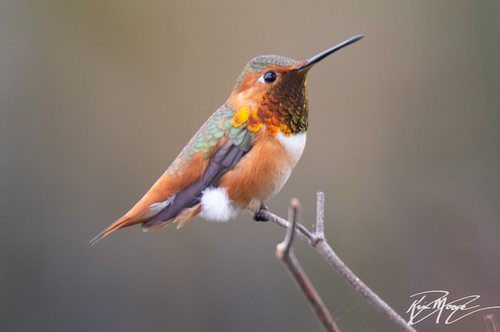
Allen's Hummingbird
Selasphorus sasin
A copper-colored jewel of the Pacific coast, the Allen's Hummingbird is a feisty aerial acrobat famous for its brilliant red throat and high-speed dives. Discover how to identify and attract this western wonder to your backyard.
Quick Identification
Size
Length: 3 to 3.5 inches (7.5–9 cm); Wingspan: 4.3 inches (11 cm); Weight: 0.1 to 0.14 oz (2–4 g).
Colors
Males feature a brilliant iridescent coppery-red throat gorget, a distinct green back and crown, and rufous flanks and tail. Females and juveniles are primarily green above with white underparts, rufous-washed flanks, and light spotting on the throat.
Key Features
- Vibrant iridescent coppery-red gorget on males
- Solid green back and crown
- Rufous-colored tail feathers and flanks
- Pendulum-like high-speed courtship flight displays
When You’ll See Them
Geographic range
Where Does the Allen's Hummingbird Live?
Native to the narrow coastal strip of western North America, Allen's Hummingbirds are primarily found breeding along the coast of California and southern Oregon. While some populations in Southern California remain year-round residents, others are long-distance migrants that travel to central Mexico for the winter. These birds are highly specialized to the Mediterranean climate of the Pacific coast, making them a signature species of the American West.
Basemap © OpenStreetMap contributors
Behavior
Allen's Hummingbirds are renowned for their feisty and highly territorial nature. Males are particularly aggressive, frequently defending nectar sources or nesting sites against much larger birds and even other hummingbird species with sharp, chattering chirps and high-speed chases. During the breeding season, males perform spectacular aerial displays, flying in high, wide arcs or 'pendulums' and diving steeply while making a distinct metallic sound with their outer tail feathers.
These birds are creatures of habit and often return to the same backyard or garden year after year. While they are mostly solitary, they interact frequently at feeders, where a strict social hierarchy often emerges. They are remarkably bold around humans, sometimes hovering just inches away from people to investigate bright clothing or a newly filled feeder. Their high metabolism requires them to feed almost constantly throughout the day.
EverydayEarth exclusive
Camera Tips
To capture the stunning iridescence of an Allen's Hummingbird, camera placement is everything. Position your AI camera within 2 to 3 feet of a hummingbird feeder or a cluster of tubular flowers like Salvia or Fuchsia. Ensure the sun is behind the camera or at a slight angle; this lighting is crucial for the male's coppery-red gorget to 'flash' or 'glow' in your footage. If the camera is facing the sun, the bird will likely appear as a dark, colorless silhouette.
Because these birds move at incredible speeds—beating their wings up to 60 times per second—you should use a camera with a high frame rate or a fast shutter speed setting to avoid motion blur. If your camera supports a 'Pre-Roll' or 'Burst' mode, enable it; hummingbirds often dart in and out of the frame so quickly that standard motion triggers might miss the start of the action. A side-profile angle at eye level (about 4 to 5 feet off the ground) usually yields the most majestic shots of their hovering flight and detailed feather patterns.
In terms of lures, avoid using red dye in your sugar water; the red parts of the feeder itself are enough to attract them. To encourage longer visits for better photos, plant native 'pollinator pockets' near your camera setup. In California, these birds are very early nesters, sometimes starting in January or February, so keep your cameras active and your feeders clean and filled during late winter to capture the first arrivals and early territorial disputes.
Similar Species
Species that look similar or are commonly confused with Allen's Hummingbird.
Frequently Asked Questions
Record Allen's Hummingbird at your habitat
Connect a camera to start building your own species record — AI identifies every visitor automatically.