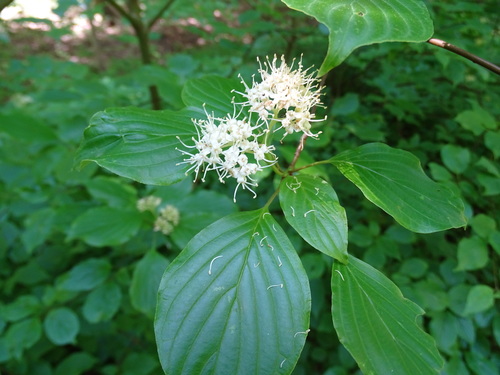
alternate-leaved dogwood
Cornus alternifolia
The alternate-leaved dogwood is a stunning 'pagoda' of the forest understory, offering elegant tiered branches and a feast for local songbirds. It is the only native North American dogwood to feature alternate leaf spacing, making it a unique find for backyard naturalists.
Quick Identification
Size
A small deciduous tree or large shrub reaching 4.5–10.5 meters (15–35 feet) in height with a spread of 6–10 meters (20–33 feet).
Colors
Deep green foliage turning reddish-purple in autumn; creamy-white flower clusters; bluish-black fruit on bright red stems; brownish-gray bark.
Key Features
- Distinctive horizontal, tiered branching pattern resembling a pagoda
- Leaves are arranged alternately along the stem (unlike most dogwoods)
- Flat-topped clusters of fragrant, creamy-white flowers
- Small, deep blue berries (drupes) supported by striking red stalks.
When You’ll See Them
Geographic range
Where Does the alternate-leaved dogwood Live?
Native to the temperate regions of eastern North America, the alternate-leaved dogwood flourishes from the maritime provinces of Newfoundland west to the edge of the prairies in southern Manitoba and Minnesota. Its range extends southward through the Appalachian Highlands and into the northern reaches of Florida and Mississippi, though it becomes increasingly rare in the heat of the deep South. While primarily a wild forest understory resident, it has been widely introduced into residential landscapes across the Midwest and Northeast as an ornamental centerpiece.
Basemap © OpenStreetMap contributors
Behavior
The alternate-leaved dogwood, often called the Pagoda Dogwood, is celebrated for its unique architectural growth habit. Unlike its cousins that feature opposite leaf arrangements, this species is defined by leaves that cluster at the ends of branches in an alternate pattern. It grows with a distinct horizontal layering that makes it a favorite for ornamental landscaping, providing a structured, elegant silhouette in the understory of larger forests or the corners of suburban gardens.
Ecologically, this tree acts as a vital hub for backyard biodiversity. In late spring, its nectar-rich flowers attract a wide variety of pollinators, including butterflies and specialized bees. As summer turns to fall, the tree produces high-fat bluish-black berries. These fruits are a critical energy source for migrating songbirds, who are often seen flitting between the tiered branches to harvest the bounty before heading south.
EverydayEarth exclusive
Camera Tips
When targeting the alternate-leaved dogwood with your trail camera, positioning is everything. Because of its unique 'pagoda' tiered branching, the best placement is at chest height (about 4-5 feet), angled slightly downward toward a middle tier of branches. This is where songbirds like Cedar Waxwings and Robins are most likely to land when feeding on the berries. If you are using an AI-powered camera, ensure the lens is at least 3-6 feet away from the nearest branch to allow the autofocus to lock onto visiting birds without blur.
To capture the best action, time your camera deployment for late summer when the berries turn deep blue. This is the 'golden window' for avian activity. Use a high-speed trigger setting or video mode, as birds move quickly when foraging. Since this tree thrives in partial shade, look for a spot where the morning sun hits the branches; this 'golden hour' lighting will make the red fruit stems pop against the dark berries, resulting in professional-quality captures.
During the spring flowering phase, you can capture stunning macro-style footage of pollinators. If your camera has a close-focusing lens or 'macro' setting, place it near a flower cluster. You don't need bait for this species—the tree itself is the lure. However, ensuring there is a nearby water source like a birdbath can encourage visitors to linger longer on the dogwood’s branches, giving your camera more time to trigger.
Similar Species
Species that look similar or are commonly confused with alternate-leaved dogwood.
Frequently Asked Questions
Record alternate-leaved dogwood at your habitat
Connect a camera to start building your own species record — AI identifies every visitor automatically.