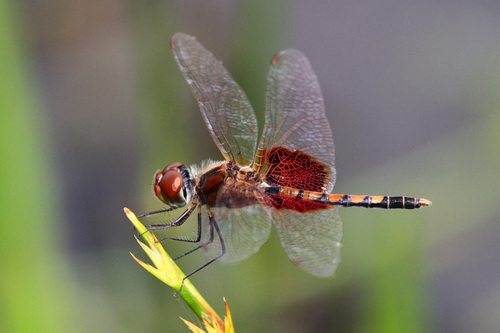
Amanda's Pennant
Celithemis amanda
A delicate jewel of the Southern wetlands, the Amanda's Pennant brings a flash of crimson or gold to the waterside. Known for its 'pennant' perching style, this small dragonfly is a master of aerial precision and a favorite for backyard naturalists.
Quick Identification
Size
Total length 25–30 mm (1.0–1.2 inches); wingspan approximately 45–55 mm (1.8–2.2 inches)
Colors
Clear wings with amber tinting and dark basal spots; males are bright red with red facial markings, while females and immatures are golden-yellow to brown.
Key Features
- Amber-washed wing bases with small dark brown patches
- Bright red (male) or yellow (female) heart-shaped spots on the abdomen
- Habit of perching on the very tips of tall grasses or twigs
- Relatively small and slender compared to other pennant species
When You’ll See Them
Geographic range
Where Does the Amanda's Pennant Live?
Amanda's Pennant is a specialist of the southeastern North American coastal plain. Its native range is concentrated primarily within the United States, stretching from the eastern edge of North Carolina down through the entirety of the Florida peninsula and westward into parts of Alabama and Mississippi. It is rarely found far from the humid, low-lying wetlands of the Deep South, making it a signature species of subtropical American freshwater ecosystems.
Basemap © OpenStreetMap contributors
Behavior
Amanda's Pennants are quintessential 'perchers,' named for their habit of sitting at the very tips of tall aquatic grasses or thin twigs. From these vantage points, they flutter out to snatch small flying insects from the air before returning to the same spot. Unlike some of the larger, more aggressive dragonflies, Amanda's Pennants have a delicate, almost butterfly-like flight pattern, especially when patrolling the margins of a pond.
These dragonflies are highly sun-dependent and are most active during the warmest parts of the day. On particularly hot afternoons, you may observe them performing an 'obelisk' posture—pointing their abdomen straight up toward the sun to minimize the surface area exposed to heat. They are generally solitary but can be found in high concentrations around preferred breeding sites like acidic bogs or shallow, vegetated pond edges.
EverydayEarth exclusive
Camera Tips
To capture the Amanda's Pennant on camera, you must take advantage of their predictable perching behavior. These dragonflies love 'sentinel posts'—stiff, vertical stalks of grass or thin woody stems that rise above the surrounding vegetation near water. If you place a few bamboo skewers or tall garden stakes near a pond edge, they will often adopt them as regular hunting perches. Position your camera to face one of these stakes at a distance that matches your lens's minimum focus capability.
Because these are small insects, a standard trail camera may struggle with trigger speed and focus. Use a camera with a dedicated macro mode or a high-speed 'burst' setting. Aim for a side-on profile to capture the distinctive amber wing patches and the colorful abdominal segments. To get the best color saturation, ensure the sun is behind you, illuminating the dragonfly's red or yellow body directly.
Shutter speed is critical if you want to catch them mid-flight. Aim for 1/2000th of a second or faster. If your camera allows for focal plane adjustment, set it to a narrow range around the perch to prevent the lens from 'hunting' against a busy background of reeds or water. Late morning, when the dew has dried but before the midday heat becomes extreme, is often the best time for crisp, clear shots.
Similar Species
Species that look similar or are commonly confused with Amanda's Pennant.
Calico Pennant
Larger with much more prominent dark heart-shaped patches across the center of the wings, whereas Amanda's patches are restricted to the base.
Halloween Pennant
Features much larger orange and black banded wings that resemble a butterfly more than a typical dragonfly.
Red-veined Pennant
Has bright red veins throughout the wings and lacks the specific amber-brown basal patches found on Amanda's Pennant.
Frequently Asked Questions
Record Amanda's Pennant at your habitat
Connect a camera to start building your own species record — AI identifies every visitor automatically.