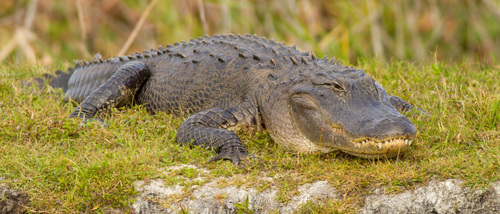
American Alligator
Alligator mississippiensis
The undisputed king of the American wetlands, the American Alligator is a living fossil that has patrolled the swamps of the South for millions of years.
Quick Identification
Size
Length: 2.5–4.6 meters (8–15 feet); Weight: 90–450 kg (200–1,000 lbs)
Colors
Dull black to dark olive-brown with creamy white undersides; juveniles feature distinct yellow horizontal banding along their bodies and tails for camouflage.
Key Features
- Broad U-shaped snout
- Lower teeth hidden when mouth is closed
- Heavily armored body with bony plates called osteoderms
- Thick, powerful tail used for propulsion
When You’ll See Them
Sightings on EverydayEarth
Jul 23, 2026
An American Alligator is captured bellowing in the water near a grassy bank. It lifts its head high, opening its mouth to reveal its teeth, while the intense low-frequency vibrations of its display cause the water to dance and ripple across its back.
Jul 20, 2026
Several American Alligators are resting in the swampy water and on the muddy banks near a wooden boardwalk. A Tricolored Heron stands patiently at the water's edge on the right side of the frame, likely hunting for small fish or insects. A white wading bird is also visible in the distance on the left bank.
Jul 17, 2026
A Snowy Egret forages along the muddy bank while a Tricolored Heron stands still in the shallow water, both likely hunting for small fish or crustaceans. In the deeper water in the background, an American Alligator floats near the reflection of a wooden walkway.
Jul 16, 2026
The camera pans across a thriving swamp rookery. In the foreground, two fluffy white Snowy Egret chicks are visible in a nest, while a Tricolored Heron perches in the branches nearby. As the view widens, a large American Alligator is seen resting on the muddy bank next to a wooden boardwalk, with another wading bird moving along the water's edge in the background.
Jul 16, 2026
A Great Blue Heron stands motionless on the muddy bank in the center of the frame, watching the water. Nearby, in the lower right, a Snowy Egret is perched on a branch just above the water's surface. In the background, an American Alligator glides slowly through the dark swamp water, leaving a small wake behind it.
Jul 16, 2026
A Tricolored Heron walks cautiously along the muddy bank in the foreground. In the background, three American Alligators float mostly motionless in the calm water, with their heads and backs breaking the surface.
Geographic range
Where Does the American Alligator Live?
The American Alligator is a quintessential resident of the North American continent, specifically dominating the humid landscapes of the Southeastern United States. Its core range stretches from the coastal marshes of North Carolina down through the entirety of Florida and westward across the Gulf Coast into the eastern portions of Texas. While they are most abundant in the deep South, healthy populations thrive in South Carolina, Georgia, Alabama, Mississippi, Louisiana, and even southern Arkansas. They are strictly a New World species and do not have native populations outside of this American stronghold.
Basemap © OpenStreetMap contributors
Behavior
American Alligators are iconic apex predators that play a crucial role in their ecosystem as 'ecosystem engineers.' During dry seasons, they use their snouts and tails to excavate 'alligator holes' in the mud. These depressions retain water when the surrounding marsh dries up, providing a life-saving refuge for fish, turtles, and wading birds. While they spend much of their day basking on sunny banks to regulate their body temperature, they are highly efficient swimmers, using their powerful tails to glide silently through the water.
Socially, alligators are more vocal and interactive than most reptiles. During the spring breeding season, males perform elaborate 'water dances' and emit deep, subsonic bellows that cause the water on their backs to dance and spray. They are also known for surprising maternal instincts; females guard their nests and will carry their hatchlings to the water in their mouths, protecting them for up to a year. While they generally avoid humans, they are opportunistic and can become dangerous if they lose their natural fear due to illegal feeding.
EverydayEarth exclusive
Camera Tips
Capturing an American Alligator on a trail camera requires focusing on 'transitional zones'—the places where water meets land. Look for 'alligator slides,' which are smooth, muddy paths where these heavy reptiles habitually enter and exit the water. To get the most impressive footage, mount your camera very low to the ground, about 12 to 18 inches high. This low-slung angle captures their powerful profile and scale, whereas a high-mounted camera often makes them look like small logs in the water.
Because alligators are most active during the low-light hours of dawn, dusk, and night, a camera with a high-quality infrared (IR) flash is essential. Standard white flashes can startle the animals and result in a 'washed out' image against their dark, reflective skin. If you are setting a camera near the water line, always account for fluctuating water levels. A sudden rainstorm can quickly submerge a camera mounted on a bank; using a waterproof security box or a screw-in tree mount slightly higher up, angled downward, provides better protection for your gear.
Baiting is never recommended for alligators as it is often illegal and creates 'nuisance' animals that associate humans with food. Instead, use the sun to your advantage. Alligators are ectothermic and must bask to warm up. Position your camera facing a sunny, south-facing bank or a partially submerged log that is clear of thick brush. During the spring months (April and May), enable the video and audio settings on your camera; you might be lucky enough to record the deep, guttural bellows and 'water dancing' of a male alligator, which is one of the most spectacular sights in the American wilderness.
Similar Species
Species that look similar or are commonly confused with American Alligator.
Frequently Asked Questions
Record American Alligator at your habitat
Connect a camera to start building your own species record — AI identifies every visitor automatically.