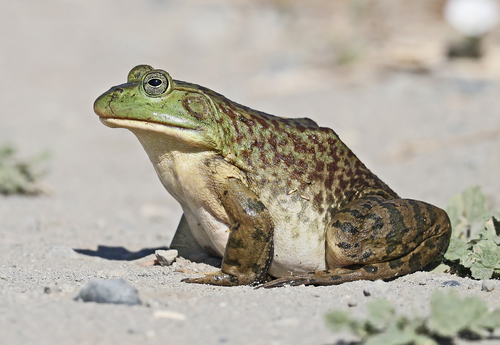
American Bullfrog
Lithobates catesbeianus
Meet the heavyweight champion of the backyard pond. Known for its deep, resonant bass and impressive leaping ability, the American Bullfrog is a fascinating apex predator of the amphibian world.
Quick Identification
Size
3.6 to 8 inches (9 to 20 cm) in length; weight typically ranges from 0.5 to 1.1 lbs (230 to 500g)
Colors
Varying shades of dull green, olive, or brown with grey or brown mottling. Undersides are creamy white to pale yellow. Males often have bright yellow throats during breeding season.
Key Features
- Large circular eardrum (tympanum) located behind the eye
- Lack of dorsolateral ridges (skin folds) along the back
- Massive, powerful webbed hind feet
- Broad, flat head with a very wide mouth
When You’ll See Them
Geographic range
Where Does the American Bullfrog Live?
Native to the eastern half of North America, the American Bullfrog's original territory stretches from the Atlantic coast to the Great Plains, and from southern Canada down to the Gulf of Mexico. However, this adaptable species has expanded significantly beyond its native borders, establishing large populations throughout the western United States, Central America, and parts of Europe and Asia. In many of these introduced regions, it is considered an invasive species due to its ability to outcompete and consume local wildlife.
Basemap © OpenStreetMap contributors
Behavior
American Bullfrogs are solitary and highly territorial ambush predators. During the day, they often sit motionless at the water's edge, perfectly camouflaged among reeds and lily pads, waiting for prey to wander too close. When threatened, they use their incredibly powerful hind legs to leap long distances into the safety of deep water, often emitting a short, high-pitched squeak as they jump.
The social life of the bullfrog is most apparent during the breeding season, when males congregate in "choruses." They produce a deep, resonant "jug-o-rum" call that can be heard from over a kilometer away. These males are notoriously aggressive, engaging in wrestling matches to defend their preferred calling sites from rivals. While they are generally wary of humans, they can become accustomed to presence in suburban ponds if not harassed.
EverydayEarth exclusive
Camera Tips
To capture high-quality footage of an American Bullfrog, place your camera just a few inches above the water line or the mudbank at the edge of a pond. Bullfrogs spend most of their time at the transition zone between land and water. A low-angle shot creates a much more immersive, "frog's-eye view" that highlights their massive size and detailed skin textures. Ensure the camera is waterproof or housed in a protective casing, as splashing is inevitable.
Because bullfrogs are cold-blooded, traditional Passive Infrared (PIR) sensors—which detect heat signatures—may struggle to trigger when the frog moves. To solve this, use a camera with a highly sensitive motion trigger or set the device to Time-Lapse mode with 30-second intervals. This ensures you capture them even when they are sitting perfectly still for long periods. If your camera allows for external triggers, a laser-break sensor across a frequent basking log is the gold standard for amphibian photography.
Lighting is crucial for night shots, which is when bullfrogs are most active and vocal. Use a camera with "No-Glow" or "Low-Glow" infrared LEDs to avoid startling the frog or causing it to retreat. If you are targeting the iconic throat-swelling "jug-o-rum" call, set your camera to video mode with a 20-30 second clip length. The best time to capture this behavior is during warm, humid nights after a rainstorm in late spring or summer.
In a backyard setting, you can encourage bullfrogs to stay in frame by providing a stable basking platform, such as a flat rock or a partially submerged log. They don't require bait, as they respond only to live, moving prey, but maintaining a healthy pond ecosystem that attracts insects will naturally keep the bullfrogs in front of your lens. During the hottest parts of the day, look for them in shaded areas under overhanging vegetation or lily pads.
Similar Species
Species that look similar or are commonly confused with American Bullfrog.
Frequently Asked Questions
Record American Bullfrog at your habitat
Connect a camera to start building your own species record — AI identifies every visitor automatically.