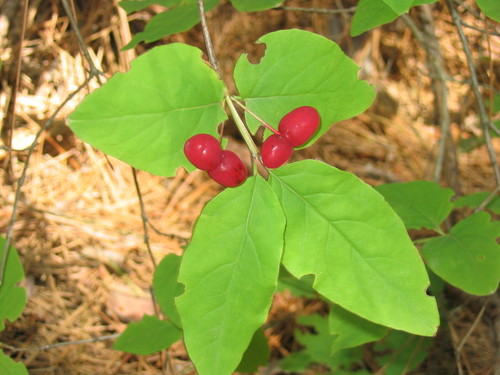
American fly-honeysuckle
Lonicera canadensis
A delicate herald of spring, the American fly-honeysuckle brightens northern forests with its twin yellow blossoms and jewel-like red berries.
Quick Identification
Size
Stands 1–2 meters (3.3–6.6 feet) tall with a similar spread
Colors
Pale yellow or greenish-yellow flowers; bright red to orange-red berries; medium green leaves with lighter undersides
Key Features
- Nodding, funnel-shaped yellow flowers that grow in pairs
- Ovoid red berries joined at the base in a 'V' shape
- Opposite, egg-shaped leaves with hairy margins and blunt tips
When You’ll See Them
Geographic range
Where Does the American fly-honeysuckle Live?
The American fly-honeysuckle is a native inhabitant of the North American continent, flourishing primarily in the temperate regions of the north. Its core range spans across Eastern and Central Canada, from Newfoundland and Labrador west to Saskatchewan, and extends south into the Northern United States, reaching through New England, the Great Lakes region, and down the Appalachian Mountains into Pennsylvania.
Basemap © OpenStreetMap contributors
Behavior
The American fly-honeysuckle is a hardy, deciduous shrub that plays a quiet but vital role in the phenology of northern forests. As one of the first woody plants to leaf out and bloom in the spring, it provides a critical early-season nectar source for bumblebees and other pollinators emerging from winter dormancy. Its growth habit is somewhat sparse and spreading, allowing it to thrive in the dappled sunlight of the forest understory without overcrowding its neighbors.
Unlike its invasive cousins, this native species is well-behaved and non-aggressive. It transitions through its life cycle quickly; the delicate, twin flowers appear in late April and are replaced by vibrant berries by mid-summer. These berries serve as a high-energy food source for forest-dwelling birds. For humans, it is a non-toxic but inedible ornamental that signals the true beginning of the spring season in colder climates.
EverydayEarth exclusive
Camera Tips
To capture the American fly-honeysuckle effectively, place your camera on a small tripod or mount it to a nearby tree at a height of approximately 3 to 4 feet. Because this shrub is a magnet for early-season birds and pollinators, you should aim your lens specifically at a cluster of flowers in late spring or the developing berries in July. Use a macro lens if possible, or ensure your trail camera has a close-focusing distance of at least 2 feet to capture the intricate detail of the fused berries.
Since the primary draw for 'wildlife' activity around this plant is avian, set your camera to 'Photo + Video' mode with a high trigger sensitivity. This will help you catch American robins or northern cardinals as they land on the thin, flexible branches to feed on the fruit. Because the branches are light, they often bob significantly when a bird lands; a fast shutter speed is essential to prevent motion blur during these brief visits.
Pay attention to the lighting. The pale yellow flowers can easily become 'blown out' or overexposed in direct midday sun. Positioning your camera to face north or south—or timing your captures for the 'golden hours' of early morning and late afternoon—will highlight the translucent quality of the petals and the deep red of the berries. If you are monitoring the plant's growth, use a time-lapse setting with one photo every 24 hours to watch the twin flowers transform into the characteristic paired fruit.
Similar Species
Species that look similar or are commonly confused with American fly-honeysuckle.
Frequently Asked Questions
Record American fly-honeysuckle at your habitat
Connect a camera to start building your own species record — AI identifies every visitor automatically.