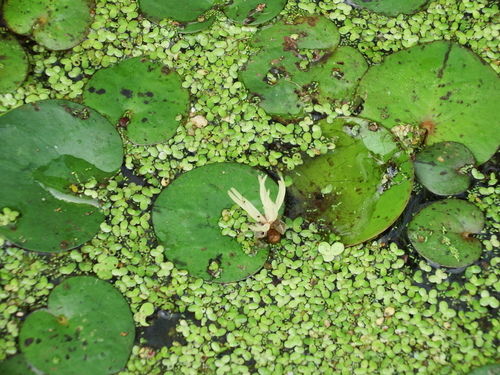
American frogbit
Limnobium spongia
A floating architect of the American South, American frogbit creates lush, emerald carpets across quiet waters, providing a vital sanctuary for frogs and dragonflies alike.
Quick Identification
Size
Individual leaves 1-10 cm (0.4-4 inches) wide; plant clusters can spread several meters via runners
Colors
Bright emerald green upper leaves; undersides often have a reddish-purple tint; flowers are small and white with yellow centers
Key Features
- Heart-shaped or circular floating leaves
- Spongy, air-filled tissue on leaf undersides for buoyancy
- Long, feathery roots that hang freely in the water
- Small three-petaled white flowers
- Horizontal stolons (runners) connecting plant clusters
When You’ll See Them
Geographic range
Where Does the American frogbit Live?
American frogbit is a quintessential North American aquatic plant, native primarily to the central and southeastern United States. Its core range stretches from the Gulf Coast of Texas across the Southern Coastal Plain to Delaware, extending northward through the fertile Lower Mississippi Valley as far as southern Illinois. While firmly rooted in the American South, it occasionally appears as a 'waif' or transient population in other states, often following human-assisted movement or extreme weather events. This species is a specialist of the lowlands, rarely straying far from the coastal plains and river basins of the American interior.
Basemap © OpenStreetMap contributors
Behavior
American frogbit is a fascinating aquatic perennial that functions as a fundamental builder of freshwater ecosystems. It primarily floats on the water's surface, using specialized spongy tissue on the underside of its leaves to stay buoyant. In shallow water or crowded conditions, the plant may transition from a floating habit to an emergent one, where the leaves grow upward on long, sturdy stalks. This adaptability allows it to compete for sunlight even in dense marsh environments.
The plant reproduces both sexually through the production of seeds and asexually through the rapid growth of runners, known as stolons. These runners allow a single plant to quickly colonize an area, creating a lush green carpet across the water. While it is a peaceful resident in its native range, its dense growth provides essential shelter for various aquatic life forms, from macroinvertebrates to small fish and amphibians, who hide beneath its thick leaf canopy.
EverydayEarth exclusive
Camera Tips
Capturing American frogbit effectively requires a camera setup focused on the interface between water and air. To get the best results, mount your camera on a low-profile tripod or a specialized water-edge stake, positioning the lens just a few inches above the water level. This low angle emphasizes the heart-shaped leaves and captures the reflection of the sky on the water, which makes for stunning, professional-grade imagery. If your camera has a macro lens or a close-focus feature, use it to capture the unique 'spongy' texture on the leaf undersides, which is a key identification feature.
Because American frogbit is a stationary plant, it serves as an excellent 'stage' for capturing animal activity. Set your AI-powered camera to trigger on movement over the leaves; you are likely to capture dragonflies basking in the sun, frogs using the leaves as hunting platforms, or turtles surfacing nearby. To minimize glare from the water surface, try to position your camera so the sun is at a 45-degree angle to the side, or utilize a polarizing filter if your camera housing allows for it.
For a truly unique perspective, consider using time-lapse settings. Setting your camera to take one photo every hour during the peak summer months will allow you to visualize the incredible speed at which the plant sends out runners and colonizes a pond surface. Ensure your camera is well-anchored, as water levels in American frogbit habitats can fluctuate rapidly after heavy rains, and you don't want your gear submerged or swept away in a sudden bayou swell.
Similar Species
Species that look similar or are commonly confused with American frogbit.
Frequently Asked Questions
Record American frogbit at your habitat
Connect a camera to start building your own species record — AI identifies every visitor automatically.