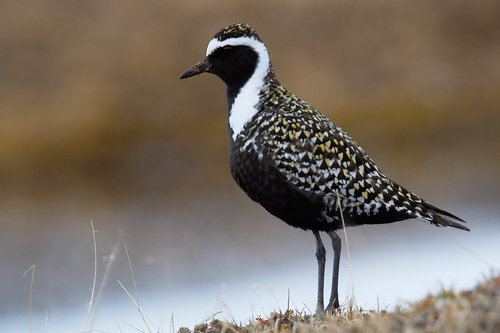
American Golden-Plover
Pluvialis dominica
The American Golden-Plover is one of nature's greatest voyagers, migrating from the Arctic tundra to the Argentine pampas every year. Its stunning golden-flecked feathers and bold 'run-and-stop' foraging style make it a prize for any backyard observer.
Quick Identification
Size
Length: 24–28 cm (9.5–11 in); Wingspan: 65–72 cm (25–28 in); Weight: 120–195 g (4.2–6.9 oz)
Colors
Breeding adults have a black face, throat, and belly with a gold-and-black spangled back; non-breeding adults are grayish-brown with subtle golden spotting.
Key Features
- Gold-flecked black back and crown
- Distinct white 'S' shape bordering the black face and neck in breeding plumage
- Long primary feathers that extend beyond the tail tip
- Straight, sturdy black bill
- Slim, long-legged silhouette
When You’ll See Them
Geographic range
Where Does the American Golden-Plover Live?
Native to the Western Hemisphere, the American Golden-Plover is a true traveler of the Americas. They breed in the high Arctic tundra of Alaska and Northern Canada before embarking on a massive southern trek to the grasslands and pampas of Argentina, Uruguay, and southern Brazil. During their spring and fall migrations, they are commonly found across the Great Plains and the Atlantic coast of the United States and Mexico, making them a seasonal highlight for birdwatchers across two continents.
Basemap © OpenStreetMap contributors
Behavior
The American Golden-Plover is a champion of avian endurance, performing one of the longest migrations of any shorebird. They travel in an 'elliptical' pattern, heading south over the Atlantic Ocean and returning north through the Mississippi Flyway. On the ground, they exhibit a classic plover foraging behavior: a rapid run followed by an abrupt stop and a quick peck to grab an insect. They are highly visual hunters, using their large eyes to detect movement in short vegetation.
While they are gregarious during migration and on their wintering grounds, often forming flocks of dozens or hundreds, they are strictly territorial when breeding in the Arctic. They are known for being wary of humans, often taking flight with a melodic, whistling call if approached. In agricultural settings, they may be seen alongside other shorebirds like Buff-breasted Sandpipers, though they generally prefer slightly drier ground than many of their cousins.
EverydayEarth exclusive
Camera Tips
To capture the American Golden-Plover on a backyard or trail camera, focus on open landscape placement. These birds are extremely averse to cover and will rarely visit areas with tall grass or nearby trees where predators might hide. If you live near agricultural land or have a large, open property, place your camera at the edge of a short-grass field or a recently tilled patch of soil. A ground-level mount is essential; placing the camera just 6-12 inches off the ground provides the best angle to showcase their intricate golden plumage and striking facial markings.
Because these birds are visual foragers attracted to bare earth or very short vegetation, you can 'lure' them by scouting for recently mowed areas or even slightly flooded patches of a field after a heavy rain. They are not attracted to traditional birdseed or suet, but they will frequent 'sod farm' style environments where earthworms and beetles are closer to the surface. Set your camera to a fast trigger speed (under 0.3 seconds) because their 'run-and-stop' movement is erratic and quick; a slow camera will often capture only a blurry tail or an empty frame.
Seasonality is the most critical factor for success. In the United States, your best window is a narrow two-week period in late April for spring migrants, or throughout September for fall migrants. Use a high-resolution setting with a fast shutter speed to freeze their movement during the bright daylight hours when they are most active. If using a motion-activated camera, set it to take short video clips (10-15 seconds) rather than just stills, as their foraging behavior—the tilt of the head and the sudden dash—is one of their most charismatic traits to document.
Similar Species
Species that look similar or are commonly confused with American Golden-Plover.
Pacific Golden-Plover
Slightly shorter wings that do not extend past the tail; generally shows more yellow/gold on the face and breast in non-breeding plumage.
Black-bellied Plover
Larger and chunkier with a much heavier bill; lacks the distinct golden spotting on the back, appearing more silver-gray.
Frequently Asked Questions
Record American Golden-Plover at your habitat
Connect a camera to start building your own species record — AI identifies every visitor automatically.