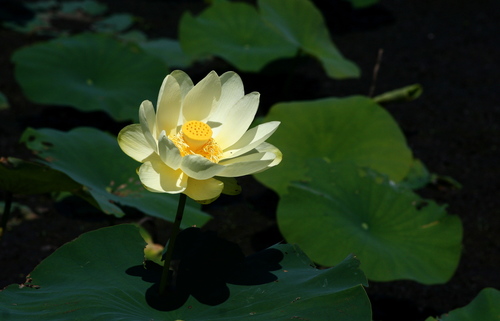
American lotus
Nelumbo lutea
With its massive umbrella-like leaves and pale yellow blooms, the American lotus is a prehistoric-looking wonder of North American wetlands. A magnet for pollinators and a sanctuary for aquatic life, it’s a stunning addition to any backyard pond or local marsh.
Quick Identification
Size
Leaves up to 60-70 cm (24-28 in) in diameter; Flowers 15-25 cm (6-10 in) wide; Stems up to 1.5 m (5 ft) tall
Colors
Pale yellow to creamy-white flowers; blue-green (glaucous) matte leaves; yellow central seed disc
Key Features
- Large, perfectly circular leaves with no notch
- Leaves and flowers held high above the water surface on stiff stalks
- Cone-shaped seed pod resembling a showerhead
- Unique water-repellent leaf surface where water beads into silver droplets
When You’ll See Them
Geographic range
Where Does the American lotus Live?
The American lotus is a quintessential North American aquatic plant, stretching its reach from the Great Lakes region in southern Ontario down to the Gulf of Mexico. It is most densely populated throughout the Mississippi River basin and the southeastern United States, though its range extends westward into Texas and Oklahoma. Beyond the mainland, it can also be found gracing the wetlands of the Caribbean islands and parts of Central America, where it thrives in the sustained warmth of the sun.
Basemap © OpenStreetMap contributors
Behavior
The American lotus is a fascinating aquatic perennial known for its heliotropic behavior, meaning its flowers and young leaves track the sun's movement across the sky. Unlike many water lilies that float directly on the surface, the American lotus typically holds its massive leaves and showy blooms several feet into the air. The flowers open early in the morning, releasing a sweet, spicy fragrance to attract beetles and bees, and close by mid-afternoon.
Ecologically, this plant is a powerhouse. Its thick, underwater rhizomes stabilize pond sediments, while the vast leaf canopy provides essential shade and cover for fish, frogs, and aquatic invertebrates. Interestingly, the plant also exhibits thermogenesis, where the flower can generate heat to enhance the spread of its scent and provide a warm environment for its insect pollinators.
EverydayEarth exclusive
Camera Tips
To capture the dramatic life of the American lotus, time-lapse photography is your best tool. Set your camera to take one frame every 30 to 60 seconds from dawn until late afternoon. This will capture the mesmerizing 'waking up' process as the pale yellow petals unfurl in the morning light and tuck back in as the sun passes its zenith. Position the camera at water level or slightly above to showcase the height of the stalks.
Because the flowers are thermogenic and fragrant, they are hotspots for insect activity. Use a macro lens or a high-resolution sensor with a fast shutter speed to freeze the action of specialized bees and beetles that crawl deep into the golden center of the bloom. To get these shots, a mounting arm attached to a dock or a weighted tripod placed in the shallows is ideal. Ensure your gear is in a high-quality waterproof housing, as humidity and sudden summer storms are common in lotus habitats.
Don't stop filming once the petals drop. The developing seed pod is an architectural marvel that attracts birds like Red-winged Blackbirds and even Wood Ducks who occasionally snack on the seeds. These pods remain standing well into the autumn. For a unique visual, wait for a rainy day; the 'lotus effect' causes rainwater to bead into shimmering silver spheres that roll across the leaf surface, which looks incredible on high-frame-rate video.
Similar Species
Species that look similar or are commonly confused with American lotus.
Frequently Asked Questions
Record American lotus at your habitat
Connect a camera to start building your own species record — AI identifies every visitor automatically.