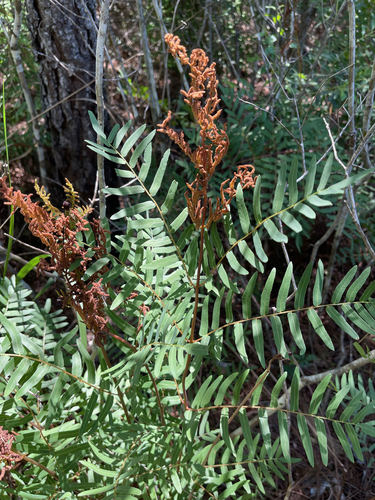
American Royal Fern
Osmunda spectabilis
An ancient wetland giant, the American Royal Fern is prized for its massive, emerald-green fronds and its unique, crown-like fertile spikes. Thriving in the wettest corners of the Americas, this 'living fossil' adds a touch of prehistoric elegance to any backyard bog or stream.
Quick Identification
Size
Stately fronds reaching 60–150 cm (2–5 ft) in height with a spread of 60–90 cm (2–3 ft).
Colors
Bright emerald green foliage; fertile spore-bearing tips turn a rich cinnamon or rusty brown.
Key Features
- Large, bipinnate fronds with widely spaced leaflets
- Fertile leaflets clustered at the very top of the frond like a 'crown'
- Distinctive bright green, leathery texture
- Clump-forming growth habit emerging from a thick woody rhizome
When You’ll See Them
Geographic range
Where Does the American Royal Fern Live?
Native to the New World, the American Royal Fern boasts an impressive range that spans nearly the entire north-to-south reach of the Americas. In the north, its territory begins in the eastern half of Canada and extends through the eastern and central United States. Moving south, it is found throughout Central America and the Caribbean, eventually reaching as far as the wetlands of Argentina and Uruguay in South America. While it is a widespread species, it is highly localized to permanent water sources and acidic soils within these regions.
Basemap © OpenStreetMap contributors
Behavior
The American Royal Fern is a long-lived perennial that brings a sense of prehistoric grandeur to wet landscapes. Unlike many other ferns that hide their spores on the undersides of leaves, this species is 'dimorphic,' meaning it produces specialized fertile leaflets at the tips of its fronds. These clusters emerge green and transform into a striking golden-brown, resembling a floral crown, which gives the plant its 'Royal' name. It is a slow-growing species that can live for decades, eventually forming massive, hummock-like root masses.
In the wild, this fern plays a vital role in wetland ecology. Its dense clumps provide essential cover for amphibians, small mammals, and nesting waterfowl. While it doesn't 'behave' in the animal sense, it is highly responsive to its environment; it will thrive and expand in consistently boggy soil but will quickly turn yellow and go dormant if its water source dries up during the peak of summer.
EverydayEarth exclusive
Camera Tips
Capturing the American Royal Fern on a trail camera requires a focus on stationary 'event' monitoring rather than movement. Because the AI might not trigger on the slow growth of a plant, set your camera to 'Time Lapse' mode. Position the camera on a tripod or a nearby tree about 2–3 feet off the ground, angled slightly downward to capture the emergence of the 'fiddleheads' (crosiers) in early spring. These emerge with a soft, hairy texture and are a highlight of backyard nature photography.
For the best visual results, look for the 'royal crown'—the fertile pinnae at the tips of the fronds—which usually appear in late spring or early summer. Backlighting is your best friend here; if you can position the camera so the morning or evening sun shines through the fronds, the bright green foliage and rusty-brown spores will appear to glow, creating a professional-grade nature shot. This lighting also helps differentiate the fern's texture from the darker forest background.
Because this species loves water, your camera may be at risk of moisture or humidity. Use a protective housing or ensure the camera is rated for high-humidity environments. If you are using an AI-powered camera like those from EverydayEarth, you can use the fern as a 'landmark' shot—once you know where the fern is, you'll likely see frogs, turtles, or even wood ducks using the plant for cover. Position your camera to include the fern in the foreground while watching a nearby water's edge for animal activity.
Similar Species
Species that look similar or are commonly confused with American Royal Fern.
Cinnamon Fern
The Cinnamon Fern produces a dedicated, separate fertile frond, whereas the Royal Fern's spores grow at the tips of its regular green fronds.
Interrupted Fern
The Interrupted Fern has fertile leaflets in the middle of the frond (interrupting the green leaves), rather than at the top like a crown.
Frequently Asked Questions
Record American Royal Fern at your habitat
Connect a camera to start building your own species record — AI identifies every visitor automatically.