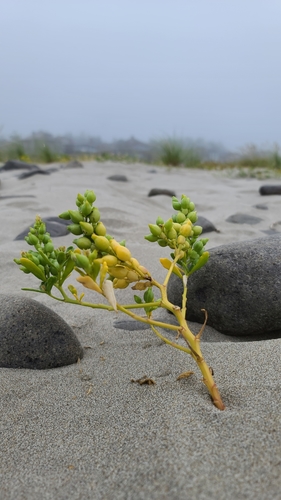
American searocket
Cakile edentula
The American searocket is a master of the shoreline, blooming in the salt-sprayed sands where few other plants dare to grow. Its unique 'rocket' pods and succulent leaves make it a fascinating pioneer of the North American dunes.
Quick Identification
Size
Height: 15–50 cm (6–20 inches); Spread: 30–90 cm (12–36 inches)
Colors
Fleshy pale green to purplish-green foliage; flowers are white to pale lavender with four petals
Key Features
- Succulent-like, fleshy leaves with wavy margins
- Small four-petaled flowers in clusters
- Distinctive two-jointed seed pods that resemble tiny rocket ships
- Found exclusively in sandy coastal dunes and beach drift lines
When You’ll See Them
Geographic range
Where Does the American searocket Live?
Native to the coastal regions of North America, the American searocket is a staple of the continent's maritime ecosystems. It is found extensively along the Atlantic coast from Newfoundland down to Florida, as well as the Pacific coast from Alaska to California. It has also successfully established itself along the freshwater sandy shores of the Great Lakes, proving its adaptability to varied coastal environments.
Basemap © OpenStreetMap contributors
Behavior
American searocket is a resilient pioneer species that thrives in the harsh, salty environment of the upper beach. It is one of the first plants to colonize the shifting sands just above the high-tide line, where it helps stabilize the soil and begin the process of dune formation. Despite the lack of shade and constant exposure to salt spray, it maintains its moisture through its thick, succulent-like leaves.
The plant exhibits a fascinating survival strategy known as dimorphic seed dispersal. Its seed pods are split into two segments: the top half eventually breaks off and is carried away by ocean currents to colonize distant shores, while the bottom half remains attached to the parent plant. This ensures that the species both expands its range and maintains its presence in a currently successful habitat.
EverydayEarth exclusive
Camera Tips
Capturing the American searocket requires a shift in mindset from tracking moving animals to observing subtle environmental changes. Because these plants grow in high-wind zones, use a low-profile ground mount or a heavy tripod to minimize camera shake. Aim your lens at a 45-degree angle to capture the unique architecture of the fleshy leaves and the delicate lavender flowers against the textured backdrop of beach sand.
For the best results, use a time-lapse setting. Program your camera to take a photo every 20 minutes over the course of a sunny weekend. This will allow you to see the flowers opening in response to the morning sun and the dramatic swaying of the plant as the coastal winds pick up in the afternoon. Ensure your camera housing is weather-sealed, as sea spray and fine sand can be abrasive to electronic components.
The American searocket is a hub for coastal biodiversity. By focusing your camera on the blooms during peak daylight hours, you are likely to capture specialized pollinators like coastal bees, hoverflies, and butterflies that are rarely seen in inland gardens. Set a fast shutter speed (at least 1/1000s) to freeze the motion of both the wind-whipped petals and the visiting insects. Avoid using heavy baits; instead, look for a healthy, blooming specimen near a drift-line where natural organic matter attracts more insect life.
Similar Species
Species that look similar or are commonly confused with American searocket.
Frequently Asked Questions
Record American searocket at your habitat
Connect a camera to start building your own species record — AI identifies every visitor automatically.