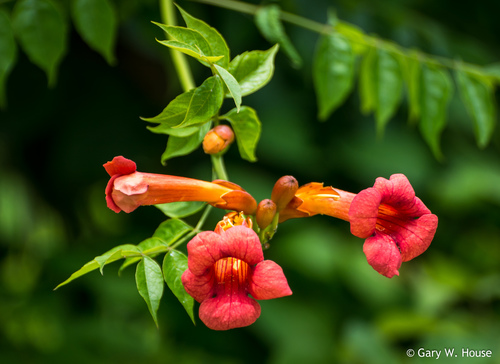
American trumpet vine
Campsis radicans
A fiery climbing powerhouse, the American trumpet vine is the ultimate nectar station for hummingbirds. Its bold, orange blossoms bring a tropical flair to temperate backyards and wild forest edges alike.
Quick Identification
Size
A woody vine reaching 10-12 meters (33-40 feet) in length; individual flowers are 7-9 cm (3-3.5 inches) long.
Colors
Brilliant orange to reddish-orange tubular flowers; dark, glossy green foliage with lighter undersides.
Key Features
- Clusters of trumpet-shaped flowers 3 inches long
- Opposite, pinnately compound leaves with 7-11 serrated leaflets
- Aerial rootlets that allow it to climb vertical surfaces
- Large, bean-like seed pods appearing in autumn
When You’ll See Them
Geographic range
Where Does the American trumpet vine Live?
Native to the Eastern and Central United States, the American trumpet vine is a staple of the American landscape from the Gulf Coast to the Great Lakes. It has successfully naturalized across the Western United States and parts of Southern Canada, thriving in USDA zones 4 through 9. Its presence is most concentrated in the humid, temperate regions of the Southeast and Midwest where it can find ample sun and vertical support.
Basemap © OpenStreetMap contributors
Behavior
The American trumpet vine is a vigorous, deciduous climber known for its aggressive growth and ability to colonize large areas quickly. It uses specialized aerial rootlets to grip onto wood, brick, and tree bark, often reaching the very top of forest canopies or garden trellises. While it is highly prized for its ornamental beauty and ability to provide rapid privacy screening, it requires regular pruning to prevent it from overwhelming structures or nearby vegetation.
Ecologically, this vine acts as a high-traffic hub for pollinators. It is evolutionarily specialized for hummingbird pollination; the long, tubular shape of the flower perfectly fits the bill of a Ruby-throated Hummingbird. Beyond its reproductive cycle, the vine provides thick cover for small birds and insects. It is also known as the "cow-itch vine" because its sap contains an irritant that can cause mild skin rashes in sensitive individuals.
EverydayEarth exclusive
Camera Tips
When monitoring American trumpet vine, your goal is usually to capture the pollinators it attracts rather than the plant growth itself. Position your camera on a tripod or mount it to a nearby post about 3-5 feet away from the most active flower clusters. A slightly downward angle is often best, as it allows the camera to see into the "throat" of the trumpet where hummingbirds and bees congregate for nectar.
Because the visitors to this plant move incredibly fast, use a camera with a high-speed trigger and set it to take multiple photos in a burst (multi-shot mode). If your camera has a "video" setting, 10-second clips are ideal for witnessing the hovering behavior of hummingbirds. Ensure the camera is aimed at flowers that receive direct morning or late afternoon sun; midday sun can create harsh shadows inside the deep tubes of the flowers, obscuring the visitors.
Seasonally, the best time for camera placement is during the peak of summer when the vine is in full bloom. You don't need any artificial lures; the bright orange flowers are the natural bait. However, choosing a cluster that is higher off the ground will yield more hummingbird activity, while lower clusters near the ground might capture interesting insect behavior or even the occasional curious mammal checking the vine's base.
Frequently Asked Questions
Record American trumpet vine at your habitat
Connect a camera to start building your own species record — AI identifies every visitor automatically.