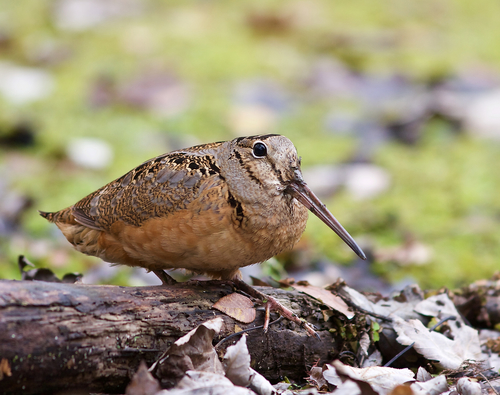
American Woodcock
Scolopax minor
With its oversized eyes and long, prehensile bill, the American Woodcock is one of the most eccentric characters of the forest floor. Known for its 'rocking' walk and spectacular twilight 'sky dance,' this master of camouflage is a favorite for backyard wildlife watchers.
Quick Identification
Size
Length: 25–30 cm (10–12 in); Wingspan: 42–48 cm (16.5–19 in); Weight: 140–230 g (5–8 oz)
Colors
Mottled mix of brown, black, and gray on the upperparts; buff-orange to cinnamon underparts; dark horizontal bars on the crown.
Key Features
- Extremely long, straight bill with a flexible, prehensile tip
- Large, dark eyes set high and far back on the head
- Stocky, short-necked body with rounded wings
- Horizontal black bars on the back of the head
When You’ll See Them
Geographic range
Where Does the American Woodcock Live?
The American Woodcock is native to the eastern half of North America, stretching from Atlantic Canada and the Great Lakes region down to the Gulf Coast. During the spring and summer, their core range covers the Northeastern United States and Southeast Canada, where they breed in early-successional forests. As temperatures drop, these migratory birds head south to winter in the dense bottomland hardwoods of the Southeastern United States, particularly in states like Louisiana, Mississippi, and Alabama.
Basemap © OpenStreetMap contributors
Behavior
The American Woodcock, affectionately known as the 'timberdoodle,' is a master of camouflage that blends seamlessly into the forest floor. Primarily crepuscular, they are most active during the twilight hours of dawn and dusk. They are famous for their unique 'rocking walk,' where they shift their body weight back and forth while stepping, a rhythmic motion believed to disturb earthworms underground, allowing the bird to detect them through vibrations.
During the spring breeding season, males perform one of nature's most spectacular displays: the 'sky dance.' This involves a series of nasal 'peent' calls on the ground followed by a high, spiraling flight. As the bird ascends, its specialized wing feathers produce a melodic whistling sound, followed by a zig-zagging descent back to the exact spot where it started. They are solitary birds outside of the mating season and are rarely seen in flight during the day unless flushed from cover.
EverydayEarth exclusive
Camera Tips
Capturing an American Woodcock on camera requires precise placement and timing. These birds are ground-dwellers that prefer the boundary between thick brush and open clearings. Set your camera at a very low height—no more than 6 to 10 inches off the ground—facing a patch of moist, soft soil or a small opening in the leaf litter. In the spring, look for 'singing grounds,' which are usually small, grassy openings near young woods. Placing a camera here between March and May is your best bet for capturing the male's iconic 'peent' calls and display rituals.
Because they are most active during the low light of dawn and dusk, the quality of your camera's night vision is crucial. Use a 'No-Glow' or invisible infrared flash to avoid startling the bird, as they can be quite skittish. Since their most interesting behaviors involve movement—the rhythmic rocking walk and the sky dance takeoff—we highly recommend using Video Mode with a high sensitivity setting. Woodcocks are small and their camouflage is so effective that they can sometimes fail to trigger sensors on lower sensitivity settings.
To attract them to a specific spot for your camera, you can manually clear a small square of heavy leaf litter to expose the damp earth. Woodcocks are attracted to these 'probe-able' areas where earthworms are easier to reach. If you have a backyard that borders a woodland, look for areas where the soil stays consistently moist, such as near a leaky outdoor faucet or a natural drainage dip. These are prime foraging spots where a well-placed camera can capture the 'timberdoodle' in action.
Similar Species
Species that look similar or are commonly confused with American Woodcock.
Frequently Asked Questions
Record American Woodcock at your habitat
Connect a camera to start building your own species record — AI identifies every visitor automatically.