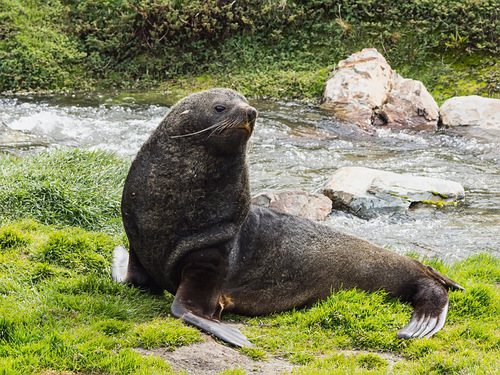
Antarctic Fur Seal
Arctocephalus gazella
The Antarctic Fur Seal is a master of transformation, having bounced back from the brink of extinction to become the most dominant predator on subantarctic shores. With their dog-like faces and incredible land mobility, they are the charismatic acrobats of the Southern Ocean.
Quick Identification
Size
Males reach 1.8–2 m (5.9–6.6 ft) and up to 200 kg (440 lbs); females are smaller at 1.2–1.4 m (3.9–4.6 ft) and 22–50 kg (48–110 lbs).
Colors
Grizzled grayish-brown to charcoal grey; creamy or pale throat and chest; adult males feature a dark, thick mane of coarse guard hairs.
Key Features
- Visible external ear flaps (pinnae)
- Long, pale whiskers (vibrissae) reaching up to 50 cm
- Ability to rotate hind flippers forward to walk or run on land
- Pointed, dog-like muzzle with a dark nose
When You’ll See Them
Geographic range
Where Does the Antarctic Fur Seal Live?
This species is a quintessential resident of the Subantarctic, with a range centered primarily on islands near the Antarctic Convergence. While the name suggests a continental presence, the vast majority of the population—nearly 95%—breeds on the island of South Georgia. Significant colonies are also established on the Kerguelen, South Shetland, South Orkney, and Macquarie Islands, where the cold, productive waters provide a constant supply of krill.
Basemap © OpenStreetMap contributors
Behavior
Antarctic Fur Seals are incredibly social and vocal marine mammals, famous for the cacophony of barks, whickers, and growls that emanate from their crowded breeding rookeries. Unlike "true" seals that crawl on their bellies, these eared seals are surprisingly agile on land; they use their powerful front flippers to prop themselves up and can outrun a human over rocky or uneven terrain. This mobility allows them to venture deep into coastal tussock grass to rest or pup.
In the water, they are world-class divers and agile hunters. While they spend much of their time at sea foraging, they return to the same subantarctic beaches year after year. Males are highly territorial and polygynous, defending harems of dozens of females during the summer breeding season. Though they generally avoid humans, they are known for their bold and sometimes feisty temperament, often standing their ground if they feel their space is being encroached upon.
EverydayEarth exclusive
Camera Tips
Capturing the Antarctic Fur Seal on camera requires equipment that can handle extreme moisture, salt spray, and sub-freezing temperatures. If you are setting up near a haul-out site or a coastal trail, use a high-quality waterproof housing and secure the camera to a heavy, immobile object like a large boulder or a deeply anchored post. These seals are notoriously curious and may "test" your equipment with their teeth; a steel security box is essential to protect the lens and housing from inquisitive pups and territorial bulls.
To get the best shots, look for "seal highways"—flattened paths through the tall tussock grass or narrow gaps between coastal rocks. Mounting the camera at a low angle (about 1-2 feet off the ground) will provide an intimate perspective of their facial expressions and impressive whiskers. Use a wide-angle lens if possible to capture the scale of the crowded rookeries without needing to place the camera too close to the animals' personal space.
For nighttime activity, ensure your camera uses No-Glow Infrared (940nm) LEDs. Traditional white flashes or even Low-Glow LEDs can startle the seals, causing them to flush toward the water, which can be dangerous for young pups. Set your trigger speed to the fastest possible setting, as these seals move with surprising speed when agitated or playing. During the peak summer months, you may need to adjust your exposure settings to account for the high-contrast environment of dark volcanic sand and bright white snow or surf.
Similar Species
Species that look similar or are commonly confused with Antarctic Fur Seal.
Frequently Asked Questions
Record Antarctic Fur Seal at your habitat
Connect a camera to start building your own species record — AI identifies every visitor automatically.