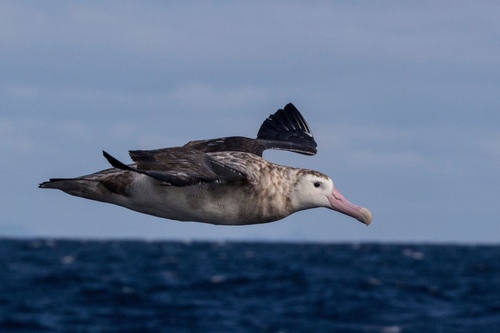
Antipodean Albatross
Diomedea antipodensis
Witness the Southern Ocean's most majestic voyager. With a wingspan that defies the wind, the Antipodean Albatross is a rare, chocolate-brown titan of the open sea.
Quick Identification
Size
Length: 110–117 cm (43–46 in); Wingspan: 2.8–3.3 m (9.2–10.8 ft); Weight: 4.5–8.5 kg (9.9–18.7 lbs)
Colors
Predominantly chocolate brown plumage that whitens with age; males are typically whiter than females but retain brown patches; pink bill with a horn-colored tip.
Key Features
- Massive wingspan over 9 feet
- Hooked pinkish bill with tubular nostrils
- Brown-and-white mottled 'scaly' plumage
- Large webbed feet for water takeoffs
- Narrow, blade-like wing shape
When You’ll See Them
Geographic range
Where Does the Antipodean Albatross Live?
Native to the Southern Hemisphere, the Antipodean Albatross is a true wanderer of the South Pacific Ocean. Its core breeding range is restricted to the remote subantarctic islands of New Zealand, specifically the Antipodes Islands, Auckland Islands, and Campbell Island. When not nesting, these birds cover a staggering geographic range that stretches from the eastern coast of Australia across the deep blue waters to the shelf-breaks off the coast of Chile.
Basemap © OpenStreetMap contributors
Behavior
The Antipodean Albatross is a master of dynamic soaring, utilizing the wind gradients over the ocean waves to travel thousands of miles with minimal flapping. They spend the vast majority of their lives at sea, only returning to land to breed every two years. These birds are socially complex, engaging in elaborate 'dances' involving bill-clapping, sky-pointing, and wing-spreading to maintain long-term monogamous bonds.
While generally solitary when foraging across the open Pacific, they can be highly competitive and vocal around fishing vessels, often scavenging scraps. On their breeding islands, they are relatively approachable but vulnerable to disturbance. Their life cycle is slow, with juveniles spending several years at sea before ever returning to land to seek a mate.
EverydayEarth exclusive
Camera Tips
Capturing an Antipodean Albatross on a trail camera is a unique challenge because they are strictly pelagic, meaning they stay far out at sea unless breeding. If you are situated on a coastal vantage point or a research vessel, position your camera at a height of 1.5 to 2 meters, angled slightly upward to catch them as they soar along the cliff thermals. Because of their incredible speed and the bright maritime environment, use a fast shutter speed (at least 1/2000s) and a high-quality UV filter to prevent salt-glare and haze from the ocean spray.
For those in specific island research zones, placing a camera near known lekking sites or nesting burrows in tussock grass is effective. Ensure the camera is ruggedized and waterproofed against extreme subantarctic conditions. Since these birds are sensitive to new objects, camouflage the camera body with matte-brown or olive tape to blend in with the peat and vegetation. Do not use artificial lures or bait, as these birds are protected and should not be habituated to human interference.
The best time to capture activity is during the Southern Hemisphere summer when parents are returning to nests to feed chicks. Set your camera for 'burst mode' to capture the rapid social interactions and wing displays. In low light, such as dawn or dusk when they are most active near the colonies, ensure your camera has excellent low-light sensor capabilities to avoid grainy images in the misty island weather.
Similar Species
Species that look similar or are commonly confused with Antipodean Albatross.
Frequently Asked Questions
Record Antipodean Albatross at your habitat
Connect a camera to start building your own species record — AI identifies every visitor automatically.