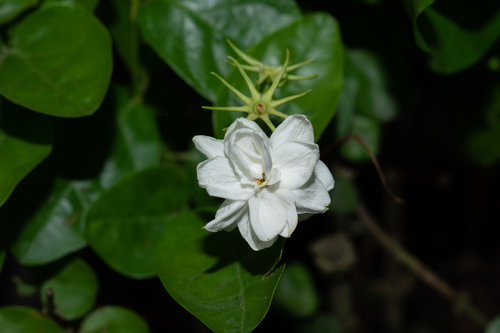
Arabian Jasmine
Jasminum sambac
The Arabian Jasmine is nature's perfume, a stunning evergreen shrub that transforms the night garden with its snow-white blooms and legendary fragrance. A favorite of nocturnal pollinators and gardeners alike, it is a centerpiece of tropical biodiversity.
Quick Identification
Size
A sprawling evergreen shrub or vine typically reaching 0.5 to 3 metres (1.6 to 10 feet) in height and spread.
Colors
Deep lustrous green foliage with waxy, pure white flowers that may turn pale pink or purple as they wilt.
Key Features
- Intensely fragrant, waxy white flowers often appearing in clusters
- Glossy, ovate evergreen leaves arranged in opposite pairs or whorls
- Vining or mounding growth habit depending on pruning
- Smooth, green young stems that turn woody and brown with age
When You’ll See Them
Geographic range
Where Does the Arabian Jasmine Live?
Native to the eastern Himalayas, Bhutan, and India, the Arabian Jasmine has become a global citizen through centuries of trade and cultivation. It is now widely established across South and Southeast Asia and has successfully naturalized in tropical and subtropical regions of the Americas, including southern Florida, the Caribbean islands, and parts of Central America. You can also find thriving populations in the wilder corners of Mauritius, Madagascar, and the Maldives where the climate remains consistently warm and humid.
Basemap © OpenStreetMap contributors
Behavior
Arabian Jasmine is a perennial evergreen known for its unique flowering cycle, where blooms typically open at night and release an intoxicating, sweet fragrance that peaks during the evening and early morning hours. This nocturnal strategy is designed to attract specific night-flying pollinators, particularly moths, which are guided to the bright white flowers by scent and moonlight.
In a backyard setting, this plant acts as a cornerstone for a 'moon garden,' providing structure and cover for small garden creatures while acting as a nectar source for various insects. While it is a robust grower in tropical climates, it remains non-invasive in most regions, though it can form dense thickets if left unpruned in ideal conditions. It is a social plant in the human sense, having been cultivated for centuries for use in teas, perfumes, and religious ceremonies.
EverydayEarth exclusive
Camera Tips
To capture the true essence of Arabian Jasmine on camera, focus on its role as a nocturnal hub for pollinators. Position your AI-powered camera on a tripod or mount it approximately 1 to 2 feet away from a dense cluster of buds that look ready to open. Use a macro lens if available, or ensure your camera is set to a close-focus mode. Because the flowers are most active at night, ensure your infrared (IR) night vision is optimized or use a low-glow external LED light to illuminate the white petals without washing them out.
Since this plant doesn't move on its own, your camera's motion trigger might not fire unless a pollinator arrives. To capture time-lapse footage of the blooms opening, set your camera to take an image every 5 to 10 minutes starting just before sunset. This is the best way to document the 'unfurling' process which usually occurs in the early evening. If you are looking for wildlife interaction, target the hours between 9 PM and midnight when Sphinx moths and other large hawkmoths are most likely to visit for nectar.
In terms of placement, choose a spot sheltered from heavy wind to prevent the branches from swaying, which can cause blurry images or false triggers. If your camera supports it, increase the sensitivity settings during the peak blooming season (mid-summer). For a unique perspective, angle the camera slightly upward from beneath a flower cluster to capture the entry of pollinators against the night sky or the dark green backdrop of the leaves.
Similar Species
Species that look similar or are commonly confused with Arabian Jasmine.
Frequently Asked Questions
Record Arabian Jasmine at your habitat
Connect a camera to start building your own species record — AI identifies every visitor automatically.