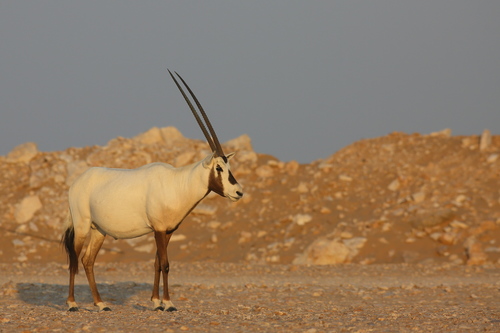
Arabian Oryx
Oryx leucoryx
The Arabian Oryx is a shimmering white icon of the desert, a species that quite literally rose from the ashes of extinction. With its rapier-like horns and striking facial mask, this resilient antelope is the ultimate master of the Arabian sands.
Quick Identification
Size
Shoulder height 81-102 cm (32-40 in); head-and-body length 140-170 cm (55-67 in); weight 65-75 kg (143-165 lb)
Colors
Brilliant white coat with chocolate-brown to black markings on the legs, a dark triangular facial mask, and dark patches where the head meets the neck. Juveniles are sandy-brown.
Key Features
- Long, straight, ringed horns reaching up to 75cm
- Reflective white coat for desert heat management
- Dark, symmetrical facial mask and leg bands
- Broad, shovel-like hooves for walking on sand
When You’ll See Them
Geographic range
Where Does the Arabian Oryx Live?
The Arabian Oryx is native to the arid landscapes of the Arabian Peninsula. Following successful reintroduction programs after being declared extinct in the wild in 1972, core populations are now established in protected reserves across Oman, Saudi Arabia, the United Arab Emirates, Jordan, and Israel. These populations represent a triumph of conservation, flourishing in some of the harshest desert environments on Earth.
Basemap © OpenStreetMap contributors
Behavior
The Arabian Oryx is a highly social and nomadic species, typically traveling in herds of 5 to 30 individuals led by a dominant male. They are master navigators of the desert, possessing an uncanny ability to detect rainfall from great distances and move toward emerging vegetation. To conserve energy and water, they are primarily crepuscular, being most active during the cooler hours of dawn and dusk, while spending the hottest parts of the day resting in shallow depressions they dig in the shade of trees or dunes.
Interaction with humans is historically complex; once hunted to near extinction, they are now largely found in protected reserves where they have become accustomed to conservation monitoring. While naturally wary, they are generally peaceful unless cornered, where they may use their formidable horns for defense. Their social structure is hierarchical, and communication involves a variety of vocalizations and scent marking.
EverydayEarth exclusive
Camera Tips
When setting up an AI-powered camera for the Arabian Oryx, placement is everything. In vast desert landscapes, focus your efforts on 'pinch points' where animals are likely to congregate. Dried riverbeds (wadis) that offer even a small amount of shade from Acacia trees are prime locations. Position your camera about 3 to 4 feet off the ground, angled slightly downward to capture both the body and the impressive length of the horns. Avoid placing cameras in direct, unshaded sun, as the glare off their brilliant white coats can lead to overexposed, 'washed out' images.
Because these animals are nomadic, they can be difficult to track consistently. If your local regulations allow, a mineral salt lick or a small water source can act as a powerful lure, especially during the height of the summer heat. Be aware that the Arabian Oryx is most active during the crepuscular hours of dawn and dusk, so ensure your camera has high-quality infrared (IR) night vision to capture clear monochrome images when the light levels are low.
For the best results, use a high trigger speed. While the Oryx often moves at a steady walk, they can be surprisingly quick when startled. Set your camera to take a multi-shot burst (3-5 photos) or a short 10-second video clip to capture the social dynamics of the herd. Check your camera’s white balance settings; because the desert environment is so bright, manually setting a lower exposure bias (-1.0 or -2.0) can help preserve the detail in their white fur during midday sightings.
Similar Species
Species that look similar or are commonly confused with Arabian Oryx.
Frequently Asked Questions
Record Arabian Oryx at your habitat
Connect a camera to start building your own species record — AI identifies every visitor automatically.