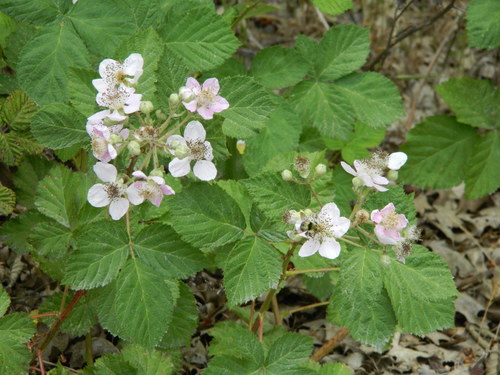
Armenian Blackberry
Rubus armeniacus
The Armenian Blackberry is a powerhouse of the backyard thicket, providing a seasonal feast for wildlife and a thorny fortress for nesting birds. While its aggressive growth can be a challenge for gardeners, it remains one of the best places to point a trail camera to witness the secret lives of suburban animals.
Quick Identification
Size
Canes can reach 10 metres (33 feet) in length; leaves are 13–25 centimetres (5–10 inches) long
Colors
Deep green leaves with silvery-white undersides; white to pale pink five-petaled flowers; glossy black berries
Key Features
- Robust, arching five-angled canes with large recurved prickles
- Leaflets typically in groups of five with distinct white-felted undersides
- Large clusters of 2-3 cm white to pinkish blossoms
- Large, succulent black fruit that does not separate from the core when picked
When You’ll See Them
Geographic range
Where Does the Armenian Blackberry Live?
Originally native to the Caucasus region of Western Eurasia, specifically Armenia and northern Iran, this species has become one of the most successful invasive plants across the globe. It is now a dominant feature of the landscape throughout temperate North America, particularly in the Pacific Northwest and Atlantic Northeast, and is widely established across Europe, Australia, New Zealand, and parts of South Africa. It excels in Mediterranean and temperate climates where it can outcompete native flora for space and resources.
Basemap © OpenStreetMap contributors
Behavior
The Armenian Blackberry is a vigorous, perennial shrub known for its aggressive "arching" growth habit. It grows with remarkable speed, with individual canes capable of extending several metres in a single growing season. A unique aspect of its behavior is its ability to reproduce vegetatively; when the tips of these long canes touch the ground, they quickly take root, allowing a single plant to expand into an impenetrable thicket that can swallow entire garden fences or creek banks.
While gardeners often struggle to contain its spread, the plant serves as a vital structural element for backyard wildlife. The dense, thorny interior of a blackberry patch creates a nearly impenetrable fortress where small mammals and songbirds can nest or hide from predators. Throughout the year, the plant shifts its role in the ecosystem, providing nectar for pollinators in the spring and a massive caloric bounty of fruit for birds and mammals in the late summer.
EverydayEarth exclusive
Camera Tips
To capture the wide variety of wildlife attracted to the Armenian Blackberry, mount your camera 3 to 4 feet off the ground, angled slightly downward toward a dense cluster of ripening berries. This positioning is perfect for filming fruit-eating birds like American Robins and Cedar Waxwings, as well as mammals like raccoons or foxes that visit the patch at dusk. Look for "tunnels" or gaps at the base of the thicket; these are often well-used animal trails where you can catch shy creatures entering or exiting their thorny cover.
During the peak fruiting months of July and August, set your camera to high sensitivity or use burst mode. Birds are incredibly fast when snatching a berry, and a slow trigger speed may leave you with nothing but a blurry wing. If your AI camera supports it, the morning hours are best for capturing the insect life—including honeybees and bumblebees—that frequent the blossoms for nectar. The white undersides of the leaves can be very reflective, so try to position the camera so that the morning sun isn't bouncing directly off the foliage into the lens.
For nocturnal monitoring, ensure that no large leaves are within 2 feet of the camera lens. The infrared flash can reflect off the glossy leaves and create a "white-out" effect, obscuring the animals in the background. If the blackberry patch is particularly dense, try clearing a small 1-foot square area directly in front of the lens to prevent wind-blown canes from causing hundreds of false triggers. This setup is highly effective for documenting how suburban wildlife uses these invasive thickets as essential habitat and food sources.
Frequently Asked Questions
Record Armenian Blackberry at your habitat
Connect a camera to start building your own species record — AI identifies every visitor automatically.