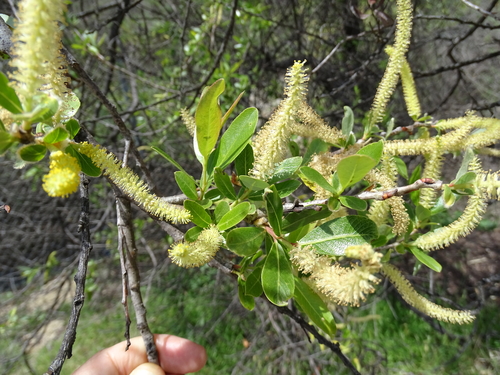
Arroyo Willow
Salix lasiolepis
The Arroyo Willow is the lifeblood of the Western stream, providing essential shade, shelter, and the first blooms of spring for a vast array of wildlife.
Quick Identification
Size
Typically grows as a large shrub or small tree reaching 2–10 meters (6–33 feet) in height with a trunk diameter up to 40 cm (16 inches).
Colors
Features dark green, shiny upper leaf surfaces with distinctively pale, silvery-white undersides. Bark is smooth and light gray on young stems, turning furrowed and dark brown on mature trunks.
Key Features
- Narrow, lance-shaped leaves with glaucous silvery undersides
- Smooth, whitish-gray bark on young branches
- Yellow-green fuzzy catkins appearing before leaf-out
- Multi-stemmed, spreading growth habit often found near water
When You’ll See Them
Geographic range
Where Does the Arroyo Willow Live?
Native to the western regions of North America, the Arroyo Willow is a signature species of the Pacific landscape. Its core range stretches from British Columbia in Canada, through the coastal and inland valleys of Washington, Oregon, and California, and extends south into the northern states of Mexico and the Baja California peninsula. It is a specialist of Mediterranean and temperate zones, thriving wherever seasonal water creates the moist soil conditions it requires to flourish.
Basemap © OpenStreetMap contributors
Behavior
The Arroyo Willow is a fast-growing, resilient pioneer species that plays a foundational role in Western North American watersheds. Unlike animals, its 'behavior' is defined by its rapid growth and remarkable ability to stabilize soil. It often forms dense, nearly impenetrable thickets that provide critical cooling shade for streams, which is essential for the survival of cold-water fish like trout and steelhead.
This species is highly adapted to the boom-and-bust cycle of riparian environments. It can survive heavy seasonal flooding and has the ability to sprout new roots from broken branches that wash downstream and lodge in moist sand. For humans and backyard observers, it acts as a magnetic hub for biodiversity, being among the first plants to provide nectar for early-emerging pollinators in late winter.
EverydayEarth exclusive
Camera Tips
To capture the wildlife that revolves around an Arroyo Willow, don't just point your camera at the trunk; focus on the 'edge' where the dense branches meet a water source or a clearing. Because this willow creates such thick cover, animals often use it as a safe 'highway' to move between habitats. Mount your camera on a sturdy branch about 3 to 4 feet off the ground, aiming at a game trail leading into the thicket or at the water's edge where thirsty visitors congregate under the willow's shade.
During the blooming season (late winter to early spring), Arroyo Willow catkins are a hive of activity. Set your camera to video mode or high-speed bursts to capture the variety of pollinators and insect-eating birds, such as warblers and flycatchers, that flock to the yellow flowers. Because willows often have many thin, flexible branches, wind can cause frequent 'false triggers.' To avoid a memory card full of swaying leaves, clear small twigs from the immediate foreground of the lens and set your camera's sensitivity to 'Medium' or use a 'Zone' trigger if your AI camera supports it.
Mammals like deer, bobcats, and gray foxes love the Arroyo Willow for its cooling shade during hot summer afternoons. If you are placing a camera in a backyard or near a creek, look for the 'bedding' areas—flattened grass or dirt under the canopy—and position your camera to catch these animals as they rest. Since these spots are often deeply shaded, ensure your camera has a high-quality infrared (IR) flash to capture crisp black-and-white images of the nocturnal traffic that uses these trees for protection at night.
Similar Species
Species that look similar or are commonly confused with Arroyo Willow.
Frequently Asked Questions
Record Arroyo Willow at your habitat
Connect a camera to start building your own species record — AI identifies every visitor automatically.