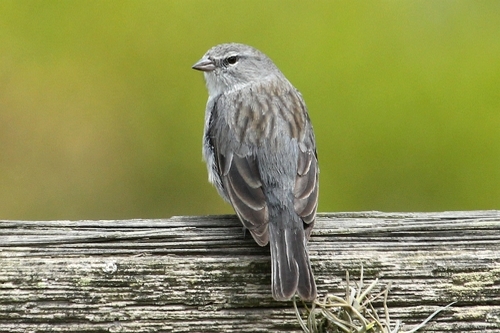
Ash-breasted Sierra-Finch
Geospizopsis plebejus
A hardy resident of the high Andes, the Ash-breasted Sierra-Finch is a master of the mountain winds. Often found in social flocks, this subtle grey bird brings life to the rugged puna grasslands and rural gardens alike.
Quick Identification
Size
12-13 cm (4.7-5.1 inches); 14-20 grams (0.5-0.7 oz)
Colors
Males are primarily pale ash-grey with faint streaking on the mantle; females and juveniles are more brownish-grey with distinct dark streaking on the breast and back.
Key Features
- Small, conical seed-eating bill
- Uniform pale grey underparts in males
- Finely streaked upperparts
- Social behavior, often found in restless flocks
- Short, notched tail
When You’ll See Them
Geographic range
Where Does the Ash-breasted Sierra-Finch Live?
The Ash-breasted Sierra-Finch is a quintessential bird of the South American Andes. Its native range spans the high-elevation corridors of Ecuador, Peru, and Bolivia, extending southward into northern Chile and the northwestern provinces of Argentina. These birds are most at home in the open, windswept landscapes of the mountain range, rarely descending into the tropical lowlands but frequently appearing in temperate valleys where agriculture provides a steady food supply.
Basemap © OpenStreetMap contributors
Behavior
EverydayEarth exclusive
Camera Tips
Capturing the Ash-breasted Sierra-Finch requires a low-profile camera setup because they are dedicated ground-foragers. Set your camera on a small tripod or mount it to a stone just 6 to 12 inches (15-30 cm) above the ground. Focus your lens on a patch of bare earth or short-cropped grass, as these birds avoid tall, dense vegetation where predators might hide. If you have a rock wall or a stony outcrop nearby, this is a perfect natural backdrop that mirrors their native habitat.
Since these birds travel in quick-moving flocks, your camera's trigger speed is critical. Set your device to its fastest response time and utilize 'burst mode' or 'photo series' to capture 3-5 frames per trigger. This increases your chances of getting a sharp image of a bird in mid-hop or with its wings spread. Because their plumage is a subtle grey, try to position the camera so the sun is behind you, providing front-lighting that helps the camera's sensor distinguish the bird from the earthy tones of the ground.
In high-altitude environments where water can be scarce, a shallow birdbath or a simple drip irrigation leak is an irresistible magnet for this species. Place your camera about 4 feet (1.2 meters) from a water source to fill the frame without scaring them off. While they aren't traditional bird-feeder visitors, they are attracted to areas where fine-grain birdseed or cracked corn has been scattered directly on the ground. Check your camera daily during the early morning hours, as this is when flock activity is at its peak and the lighting is most dramatic.
Similar Species
Species that look similar or are commonly confused with Ash-breasted Sierra-Finch.
Plumbeous Sierra-Finch
Uniformly darker slate-grey plumage with less streaking and a more robust appearance than the Ash-breasted.
Mourning Sierra-Finch
Noticeably larger with a bold black patch on the chest and more complex white and black facial markings.
Band-tailed Sierra-Finch
Distinguished by its bright yellow bill and white outer tail feathers that flash vividly during flight.
Frequently Asked Questions
Record Ash-breasted Sierra-Finch at your habitat
Connect a camera to start building your own species record — AI identifies every visitor automatically.