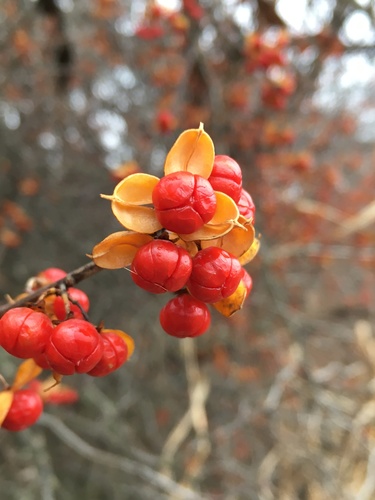
Asian bittersweet
Celastrus orbiculatus
A stunning but relentless climber, Asian bittersweet is famous for its vibrant autumn fruit and its habit of twining around everything in its path. While it provides a vital winter feast for birds, this invasive vine is a powerful force of change in the backyard landscape.
Quick Identification
Size
A woody vine reaching 12–18 meters (40–60 feet) in length with stem diameters up to 10 centimeters (4 inches).
Colors
Glossy green leaves turning bright yellow in autumn; small greenish flowers; yellow fruit capsules that split to reveal scarlet-red seeds.
Key Features
- Rounded, finely-toothed leaves with a pointed tip
- Flowers and fruit clusters emerge from leaf axils along the stem
- Bright red seeds with yellow husks visible in fall and winter
- Vigorous twining stems that spiral tightly around host trees
When You’ll See Them
Geographic range
Where Does the Asian bittersweet Live?
Originally native to East Asia, spanning China, Japan, and the Korean Peninsula, Asian bittersweet was introduced to North America in the mid-1800s as an ornamental plant. Today, it has established a massive invasive footprint across the eastern and midwestern United States, from Maine to Georgia and as far west as Iowa and Arkansas. It is particularly prevalent in temperate regions where suburban landscapes meet natural woodland edges, allowing it to bridge the gap between manicured gardens and wild forests.
Basemap © OpenStreetMap contributors
Behavior
In the backyard ecosystem, this plant acts as a pioneer species on forest edges and disturbed ground. It is highly opportunistic, quickly overtopping the canopy of its hosts to monopolize sunlight. This behavior often leads to the eventual collapse of the host tree due to the sheer weight of the vine mass, especially during heavy snow or wind events. Despite its destructive nature to local flora, it plays a significant role in late-season wildlife feeding, as its abundant fruit is a primary energy source for many wintering species.
EverydayEarth exclusive
Camera Tips
Capturing the activity around an Asian bittersweet vine requires focusing on two distinct phases: its aggressive seasonal growth and its role as a winter food source. To document the growth, use a time-lapse setting on your camera during the spring and summer. Mounting the camera on a sturdy post about 10 feet away from a climbing vine allows you to capture its 'searching' behavior as the lead stems spiral through the air looking for a host. One frame every 6 to 12 hours will create a dramatic sequence of the vine engulfing its surroundings.
The most exciting wildlife footage occurs in late autumn and early winter when the berries are ripe. Position your camera close to a 'fruiting bridge'—a horizontal section of the vine heavy with red and yellow berries. Set the camera at eye level (roughly 4 to 5 feet high) and use a high-sensitivity trigger. This is the peak time to capture birds like Cedar Waxwings, Northern Cardinals, and Blue Jays as they hover and pluck the seeds. Because the berries are bright red, they offer excellent contrast for daytime photos, but ensure your camera is not pointing directly into the sun to avoid washing out these vibrant colors.
In winter, bittersweet becomes a hub for activity when other food sources are scarce. If you have a trail camera with a 'hybrid' mode, use it to capture both high-resolution stills of the birds and short 10-second videos of the feeding behavior. Be mindful of the wind; the thin, flexible stems of the vine can move significantly in a breeze, which might lead to hundreds of false triggers. To prevent this, reduce the PIR sensitivity slightly or clear away any small, loose twigs that are directly in the foreground of the lens.
Similar Species
Species that look similar or are commonly confused with Asian bittersweet.
American Bittersweet
Native to North America; fruit and flowers only grow in terminal clusters at the branch tips, and leaves are typically more oblong than round.
Common Buckthorn
A shrub rather than a vine, but often found in the same habitat with similar dark green leaves and bird-dispersed fruit.
Frequently Asked Questions
Record Asian bittersweet at your habitat
Connect a camera to start building your own species record — AI identifies every visitor automatically.