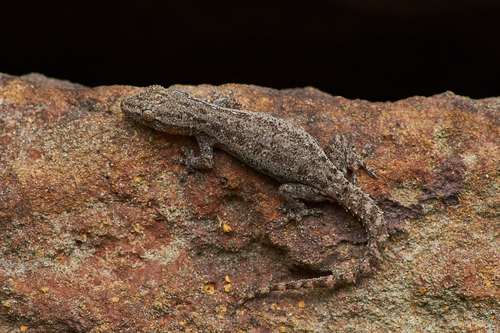
Asian House Gecko
Hemidactylus frenatus
The Asian House Gecko is the ultimate backyard acrobat, famous for its 'chuck-chuck' call and its ability to sprint across ceilings while hunting insects.
Quick Identification
Size
7.5 to 15 cm (3 to 6 inches) in total length; weight ranges from 2 to 5 grams (0.07 to 0.18 oz)
Colors
Usually pale tan, grayish-white, or creamy, often appearing translucent at night; darker mottled patterns may appear during the day for camouflage
Key Features
- Large adhesive toe pads for vertical climbing
- Lidless eyes with vertical pupils and clear protective scales
- Distinctive 'chuck-chuck-chuck' vocalization
- Rows of small, spine-like tubercles along the back and tail
When You’ll See Them
Geographic range
Where Does the Asian House Gecko Live?
Originally native to the warm climates of South and Southeast Asia and parts of Near Oceania, the Asian House Gecko has become one of the most successful invasive reptiles on the planet. It is now firmly established across much of tropical and subtropical Australia, the southern United States (especially Florida and Texas), Central America, and parts of Africa. Because they travel easily in cargo and shipping containers, their range continues to expand into almost any region with a sufficiently warm, humid climate and human infrastructure.
Basemap © OpenStreetMap contributors
Behavior
Asian House Geckos are remarkable urban survivors, famously known for their 'social' nature and vocalizations. Unlike most lizards, they are highly audible, making a series of clicking sounds that resemble a loud 'chuck-chuck-chuck.' They are primarily nocturnal and have developed a clever survival strategy: they congregate near artificial light sources on the exterior of buildings to hunt the insects attracted to the glow.
These geckos are highly territorial and can often be seen chasing away rivals or engaging in small skirmishes over prime hunting spots. Despite their competitive nature with each other, they are harmless to humans and are often viewed as beneficial guests because they consume large quantities of household pests like mosquitoes, moths, and small cockroaches. They are bold and frequently venture inside homes, resting behind picture frames or clocks during the day.
EverydayEarth exclusive
Camera Tips
To capture these tiny acrobats, position your camera near an outdoor light source, such as a porch light or security lamp. This is where the geckos congregate to hunt insects. Because they are small and move quickly, set your camera's trigger speed to the fastest possible setting and ensure you are using a macro or close-focus lens if available. Mounting the camera 1–2 meters (3–6 feet) away from a flat wall where they frequent is ideal.
Standard PIR (Passive Infrared) motion sensors on trail cameras can sometimes struggle with small, cold-blooded reptiles. To improve your chances, look for 'time-lapse' modes that take photos at regular intervals, or use an AI-powered camera specifically tuned for small movement detection. If you are using a traditional camera, try to angle it parallel to the wall rather than directly at it to capture the gecko's profile and toe pads as it climbs.
Baiting isn't usually necessary if there is a light source, but you can increase 'traffic' by leaving a very small dish of honey or mashed fruit nearby, which attracts the ants and flies they love to eat. Be mindful of the flash; while these geckos aren't easily spooked by light, a heavy white flash might wash out their translucent skin. If your camera allows it, use a low-intensity 'no-glow' infrared flash to capture their natural hunting behavior without overexposing the image.
Similar Species
Species that look similar or are commonly confused with Asian House Gecko.
Frequently Asked Questions
Record Asian House Gecko at your habitat
Connect a camera to start building your own species record — AI identifies every visitor automatically.