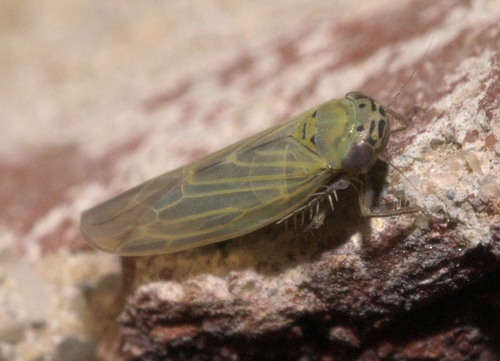
Aster Leafhopper
Macrosteles quadrilineatus
The Aster Leafhopper is a tiny, lime-green acrobat of the insect world, famous for its six-spotted 'face' and its incredible ability to migrate thousands of miles on the wind.
Quick Identification
Size
3.5–4 mm (0.14–0.16 inches) in length
Colors
Pale yellowish-green to lime green body with clear wings; characterized by six small black spots on the vertex (forehead) arranged in three pairs.
Key Features
- Six distinct black spots on the forehead arranged in pairs
- Wedge-shaped, slender body tapering toward the rear
- Translucent wings that extend past the abdomen
- Powerful hind legs designed for rapid jumping
When You’ll See Them
Geographic range
Where Does the Aster Leafhopper Live?
The Aster Leafhopper is a widespread resident of North America, stretching from the northern reaches of Canada down through the entire continental United States and into Mexico. In the spring, they are particularly abundant in the Midwest and Great Lakes regions as they migrate northward from their southern breeding grounds on the wings of warm southerly winds. They are highly adaptable and thrive in almost any temperate or subtropical environment where leafy vegetation and grasses are present, making them a staple of backyard biodiversity across the continent.
Basemap © OpenStreetMap contributors
Behavior
The Aster Leafhopper is a high-energy insect known for its remarkable agility and 'spring-loaded' escape mechanism. When disturbed, they don't just fly; they use their specialized hind legs to launch themselves into the air with incredible speed, a trait that gives them their common name. They are primarily diurnal, spending their daylight hours moving through garden foliage and grassy areas to feed on plant sap.
These insects are highly mobile and are famous for their long-distance migratory patterns. Unlike many other backyard insects that overwinter locally, Aster Leafhoppers are known to ride warm wind currents from the southern United States into northern regions each spring. In a backyard setting, they are usually found on the undersides of leaves, where they are protected from direct sun and predators while they feed. While they are solitary feeders, you will often find dozens of them in a single garden patch if the host plants are particularly healthy.
EverydayEarth exclusive
Camera Tips
Capturing the Aster Leafhopper on camera requires a specialized macro setup because they are too small for traditional trail cameras to trigger or focus on. To see them with an AI-powered backyard camera, you must use a device designed for close-up observation, such as a smart insect house or a bird feeder camera with a macro lens attachment. Position the lens 4 to 10 inches away from known host plants like asters, marigolds, or leafy greens. Since these leafhoppers prefer the undersides of leaves, placing your camera at a low angle looking slightly upward toward the foliage will yield the best results.
Because they are triggered by movement and light, ensure your camera is placed in a sunny spot. The high light levels allow your camera to use a faster shutter speed, which is essential for capturing a clear image of an insect that can leap out of the frame in a fraction of a second. If your camera has a 'high sensitivity' setting for motion detection, enable it, as the small mass of a leafhopper may not always trigger standard sensors. High-resolution video is often better than still photos for this species, as it allows you to see their characteristic 'sideways' walking motion and sudden jumps.
Seasonality is key for recording this species. In the northern United States and Canada, the best time to set up your camera is in late spring after a period of strong southerly winds, which brings the migrants into the area. Keep the area around your camera free of heavy swaying branches that might cause 'false triggers,' but leave the small weeds or grasses they prefer. If you want to see them 'up close and personal,' try placing a small LED light near the camera at dusk, as they are occasionally attracted to light sources, though they are most active during the day.
Similar Species
Species that look similar or are commonly confused with Aster Leafhopper.
Frequently Asked Questions
Record Aster Leafhopper at your habitat
Connect a camera to start building your own species record — AI identifies every visitor automatically.