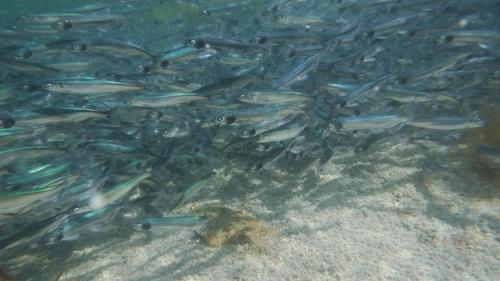
Atlantic Capelin
Mallotus villosus
The Atlantic Capelin is the shimmering silver pulse of the North Atlantic, driving the marine food web. Known for their legendary 'rolls' where millions of fish storm the beaches to spawn, they are a seasonal wonder of the arctic and subarctic coasts.
Quick Identification
Size
Males reach 20 cm (8 in), while females grow slightly larger up to 25.2 cm (10 in).
Colors
Olive-green on the back (dorsal side) shading to shimmering silver on the sides and belly; males develop reddish iridescent tones during spawning.
Key Features
- Slender, elongated body with olive and silver coloration
- Males possess a translucent, hairy-looking ridge along their sides during spawning
- Small mouth with minute teeth and large eyes
- Deeply forked tail fin
When You’ll See Them
Geographic range
Where Does the Atlantic Capelin Live?
Native to the cold, subarctic and arctic waters of the Northern Hemisphere, the Atlantic Capelin is found throughout the North Atlantic and Arctic Oceans. Its core range includes the waters off the coasts of Canada (specifically Newfoundland and Labrador), Greenland, Iceland, and Norway’s Barents Sea, reaching as far south as the Gulf of Maine. While they primarily inhabit deep offshore waters, they are seasonally famous for crowding the shorelines of these northern nations during their spectacular annual spawning runs.
Basemap © OpenStreetMap contributors
Behavior
Atlantic Capelin are highly social, pelagic forage fish that spend most of their lives in the open ocean, traveling in massive, synchronized schools. They are migratory by nature, following the retreat of Arctic sea ice to graze on nutrient-rich plankton blooms. As a primary food source for a vast array of marine life, their movements dictate the distribution of predators like cod, humpback whales, and various seabirds.
The most famous behavior of the capelin is the 'roll'—a dramatic mass-spawning event. During early summer, millions of fish migrate to coastal beaches. Males and females swim into the wash of the waves to deposit and fertilize eggs in the sand or fine gravel. This event is physically exhausting; while some females survive to spawn again, the post-spawning mortality rate for males is nearly 100%.
EverydayEarth exclusive
Camera Tips
Capturing the 'Capelin Roll' requires a departure from standard backyard camera setups. Since these fish are aquatic, your best results will come from using a waterproof action camera or a trail camera mounted in a rugged, submersible housing. During the spawning season, position your camera on a weighted tripod at the low-tide line, facing toward the shore. This allows you to capture the moment the waves carry thousands of shimmering fish onto the sand.
Because capelin frequently spawn under the cover of darkness or during the dim light of dawn and dusk, high-quality infrared or white LED flash is essential. If you are using an AI-powered camera near the shoreline, set it to a high sensitivity with a fast trigger speed; the motion of the waves combined with the flickering silver of the fish can create incredible, high-energy footage. A high frame rate (60fps) is recommended to slow down the action of the 'roll' in post-production.
Don't just point your camera at the water. The arrival of capelin triggers a predatory frenzy. Consider placing a second camera directed at the sky or the nearby rocks. You are likely to capture spectacular shots of gulls, gannets, and eagles diving into the surf, or even seals and whales breaking the surface just offshore. For a unique 'fish-eye' perspective, place a submersible camera in a shallow tide pool where fish often become temporarily trapped as the tide recedes.
Safety and timing are the final pieces of the puzzle. Check local tide tables and lunar cycles, as spawning often peaks around the full or new moon. Ensure your equipment is securely tethered, as the North Atlantic surf is powerful enough to sweep away even heavy tripods. If your camera has a 'time-lapse' mode, use it during the peak of the run to compress hours of silver-scaled chaos into a breathtaking few seconds of video.
Similar Species
Species that look similar or are commonly confused with Atlantic Capelin.
Rainbow Smelt
Rainbow Smelt have much larger, more visible scales and larger teeth compared to the fine-scaled, small-toothed Capelin.
Atlantic Silverside
Silversides have a distinct, bright silver stripe along their sides and two separate dorsal fins, whereas Capelin have a more uniform silver side and a single dorsal fin.
American Sand Lance
Sand Lance have a much more eel-like, slender body and lack the adipose fin found on the back of the Capelin.
Frequently Asked Questions
Record Atlantic Capelin at your habitat
Connect a camera to start building your own species record — AI identifies every visitor automatically.