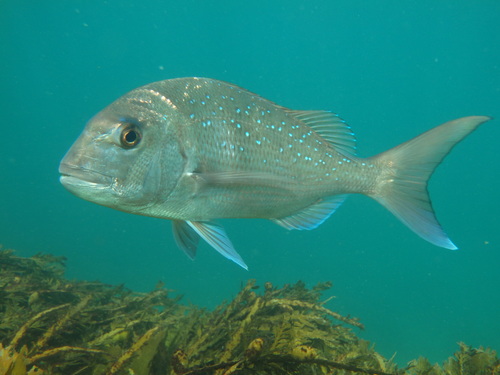
Australasian Snapper
Chrysophrys auratus
With its shimmering pink scales and iridescent blue spots, the Australasian Snapper is the crown jewel of the Pacific reefs. A favorite for both photographers and coastal observers, this clever fish thrives from the shallow estuaries to the deep rocky reefs.
Quick Identification
Size
Typically 30–80 cm (12–31 in), but can reach 100 cm (39 in); weight ranges from 1–15 kg (2.2–33 lbs).
Colors
Adults are a striking coppery-pink to reddish-gold on the upper body, fading to a silvery-white belly. They are most famous for the scattered iridescent neon-blue spots on their upper flanks.
Key Features
- Deep, compressed body with a large, bony head
- Brilliant iridescent blue spots on the upper sides
- Powerful jaws equipped with peg-like teeth for crushing shells
- Deeply forked tail often edged with a darker hue
When You’ll See Them
Geographic range
Where Does the Australasian Snapper Live?
Native to the coastal waters of the Southern and Western Pacific, the Australasian Snapper has a unique disjunct distribution. In the Southern Hemisphere, they are found in high concentrations around the southern half of Australia and throughout the coastal shelf of New Zealand. In the Northern Hemisphere, separate populations inhabit the waters of the Philippines, Indonesia, China, Taiwan, and Japan. They are primarily coastal dwellers, rarely venturing into the deep open ocean far from the continental shelf.
Basemap © OpenStreetMap contributors
Behavior
Australasian Snapper are highly intelligent and social fish, though their behavior changes significantly as they age. Juveniles, often called 'squire,' tend to congregate in large schools within protected estuaries and shallow coastal bays. As they mature, they move into deeper reef systems and become more solitary or travel in smaller, loosely knit groups. They are known for their curiosity and can often be seen investigating new objects in their environment, making them excellent subjects for underwater observation.
These fish are opportunistic feeders that exhibit a 'rummaging' behavior along the seafloor. They use their powerful heads to disturb the sediment or poke into crevices in search of prey. In areas with high human activity, such as piers or popular diving spots, they can become quite bold, occasionally approaching divers or cameras if they associate the area with food sources.
EverydayEarth exclusive
Camera Tips
Capturing the Australasian Snapper requires an underwater setup, such as a waterproof action camera or a specialized dock-mounted system. If you live on a canal or near a jetty, mounting a camera to a pylon just below the low-tide mark is highly effective. Angle the camera slightly downward toward the seafloor, as Snapper spend most of their time foraging in the substrate. Ensure the camera is positioned to capture natural light; midday sun provides the best penetration through the water column for clear, colorful footage.
To attract Snapper to your camera's field of view, use a 'burley' or bait cage. A mesh bag filled with crushed pilchards, oily fish scraps, or even crushed shellfish will create a scent trail that these fish find irresistible. Secure the bait about 1 to 2 meters away from the lens to ensure the fish stay within the focal range. Avoid placing the bait too close, or the resulting footage may be obscured by smaller baitfish 'swarming' the source.
Patience is key, as larger, older Snapper are naturally more cautious than juveniles. You will often see smaller 'squire' arrive first, followed by the larger, more dominant fish once they feel the area is safe. For the best clarity, try to deploy your camera during a rising tide when the water is typically clearer. If filming at night, use an infrared light source rather than a bright white LED, as white light can startle the fish or reflect off suspended particles, causing 'backscatter' that ruins the image quality.
Similar Species
Species that look similar or are commonly confused with Australasian Snapper.
Frequently Asked Questions
Record Australasian Snapper at your habitat
Connect a camera to start building your own species record — AI identifies every visitor automatically.