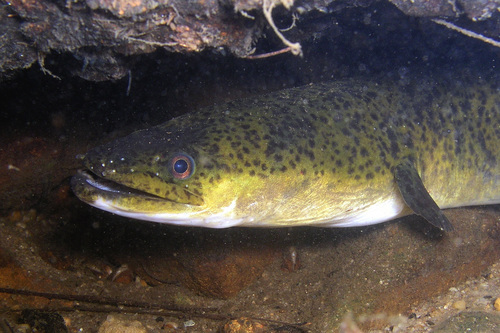
Australian Long-finned Eel
Anguilla reinhardtii
Australia's largest freshwater eel, the Long-finned Eel is a marbled giant known for its incredible overland journeys and secret nocturnal life.
Quick Identification
Size
Length up to 1.6m (5.2 ft); weight up to 22kg (48 lbs). Females are significantly larger than males.
Colors
Olive-green to brownish-bronze back with distinct dark brown mottling or 'marbling'; belly is pale cream or silvery-white.
Key Features
- Dorsal fin starts much further forward than the anal fin
- Dark, leopard-like marbling across the back and sides
- Large, wide mouth with thick, fleshy lips
- Long, snake-like cylindrical body
When You’ll See Them
Geographic range
Where Does the Australian Long-finned Eel Live?
Native to the vast Oceania region, the Australian Long-finned Eel primarily occupies the eastern drainage of the Australian continent. Its core range extends from the tropical waters of Cape York in Queensland, winding down through New South Wales and Victoria, and reaching the temperate streams of Tasmania. Beyond the Australian mainland, this hardy species thrives in the river systems of New Caledonia and Lord Howe Island, and is a frequent inhabitant of coastal waterways throughout the South Pacific.
Basemap © OpenStreetMap contributors
Behavior
The Australian Long-finned Eel is a stealthy, nocturnal predator that dominates many of Australia's freshwater ecosystems. During the day, they are master hiders, tucking themselves into hollow logs, under overhanging banks, or burying themselves in soft river sediments. As night falls, they become highly active, using a sophisticated sense of smell to navigate and hunt in near-total darkness. They are famous for their strength and ability to move against strong currents, even climbing wet dam walls and waterfalls.
One of their most remarkable behaviors is their ability to travel across land. During periods of heavy rain or high humidity, they can slither across wet grass and through damp leaf litter to reach landlocked ponds or move between disconnected waterways. Although they spend decades in freshwater, they are catadromous, meaning they eventually undertake a massive migration of thousands of kilometers into the Pacific Ocean to spawn and die.
EverydayEarth exclusive
Camera Tips
To capture the elusive Australian Long-finned Eel, your best bet is a waterproof action camera or a trail camera positioned at the water's edge. Because these eels are almost exclusively nocturnal, ensure your camera has high-quality infrared (IR) or 'no-glow' flash capabilities. If you are using a trail camera, mount it on a stake or low-hanging branch about 1-2 feet above the water surface, angled downward toward a shallow bank or a flat rock where the eel might surface or hunt.
One of the most fascinating behaviors to film is their overland migration. During periods of heavy rain or high humidity, these eels can travel across land. Position your camera along 'wet paths' between two bodies of water—like the grass between a creek and a backyard pond. For the best results, use a high-protein bait like oily sardines or cat food placed inside a weighted PVC pipe with holes drilled in it; this keeps the bait from being carried away by the current while drawing the eel directly in front of your lens.
In terms of settings, use 'Hybrid Mode' if your camera supports it, capturing a high-resolution still followed by a 20-30 second video clip. These eels move with a slow, serpentine grace that is much better captured on video than in photos. Set your trigger sensitivity to high, as the smooth, cool skin of an eel may not always trigger traditional PIR sensors as effectively as a warm-blooded mammal. If you are filming underwater, ensure the water is clear; murky water will reflect IR light and 'white out' your footage.
Frequently Asked Questions
Record Australian Long-finned Eel at your habitat
Connect a camera to start building your own species record — AI identifies every visitor automatically.