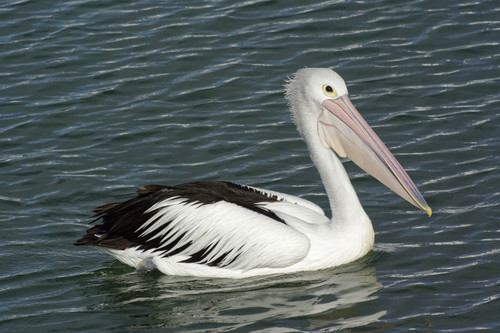
Australian Pelican
Pelecanus conspicillatus
Boasting the longest bill in the avian world, the Australian Pelican is a masterpiece of prehistoric design and graceful flight. These iconic white giants are the kings of the coastline, equally at home soaring on thermal currents as they are patrolling suburban piers.
Quick Identification
Size
Length: 1.6–1.8 m (5.2–5.9 ft); Wingspan: 2.3–2.5 m (7.5–8.2 ft); Weight: 4–13 kg (9–29 lbs)
Colors
Mainly white body with black primary feathers on the wings and tail; bill and throat pouch are pink; legs and feet are blue-grey.
Key Features
- Massive pink bill and throat pouch (longest bill of any bird)
- Huge wingspan with distinct black trailing edges
- Yellow or pale pink eye-ring
- Heavy, white body with blue-grey legs
When You’ll See Them
Geographic range
Where Does the Australian Pelican Live?
The Australian Pelican is native to the continent of Oceania, with its primary range spanning the entirety of Australia and New Guinea. These birds are highly nomadic, frequently traversing the Australian interior to find ephemeral waterways, while maintaining stable populations along the coastlines of Fiji and Indonesia. While they are most abundant in Australia, they are also recorded as regular vagrants in New Zealand, often arriving after significant weather events or during periods of drought on the mainland.
Basemap © OpenStreetMap contributors
Behavior
The Australian Pelican is a highly social bird, often found in large colonies on both coastal and inland waters. They are masters of the air, utilizing thermals to soar for hundreds of kilometers with minimal effort, reaching altitudes of up to 3,000 meters. On the water, they are cooperative hunters, frequently working together in groups to drive schools of fish into shallow water where they can be easily scooped up in their massive pouches.
While they are iconic sights at fish markets and boat ramps where they scavenge for scraps, they are naturally nomadic. They have an uncanny ability to detect rainfall hundreds of kilometers away, prompting massive migrations to Australia's ephemeral inland lakes for breeding. Despite their size, they are surprisingly quiet, usually only making low grunts during the nesting season.
EverydayEarth exclusive
Camera Tips
To capture the majesty of an Australian Pelican on camera, placement near the water's edge is essential. Focus on low-lying sandbars, jetties, or the margins of estuaries where the birds frequently haul out to preen and rest. Set your camera at a low angle, approximately 30-50 centimeters off the ground; this provides a 'bird's eye view' that emphasizes their massive scale and creates a more intimate portrait against the water's reflection.
Lighting is your biggest challenge with this species. Because they are predominantly white, they are prone to 'blowing out' or overexposing in direct midday sun. To get the best detail in their feathers, aim for the golden hours of early morning or late afternoon. If your camera allows for exposure compensation, consider setting it to -0.3 or -0.7 to preserve the texture in their white plumage. Fast shutter speeds are a must if you hope to catch their 'bill-yawn' or the moment they strike the water, as their movements are deceptively quick.
While it may be tempting to use fish as bait, it is highly discouraged as it can lead to aggressive behavior and health issues for the birds. Instead, look for natural 'cleaning stations' near boat ramps or areas where local fishermen naturally congregate, as pelicans will often linger here for hours. During the breeding season, look for cameras with wide-angle lenses to capture the dramatic pink and chrome-yellow colors that develop on their bills, which is a spectacular sight for any backyard or trail cam enthusiast.
Similar Species
Species that look similar or are commonly confused with Australian Pelican.
Frequently Asked Questions
Record Australian Pelican at your habitat
Connect a camera to start building your own species record — AI identifies every visitor automatically.