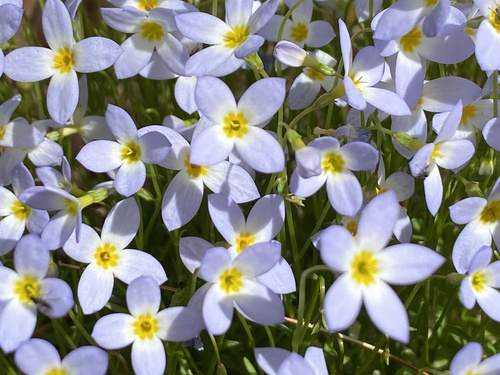
azure bluet
Houstonia caerulea
A delicate herald of spring, the azure bluet carpets meadows and lawns in a sea of pale blue stars. Known fondly as 'Quaker Ladies,' these tiny perennials are a vital early-season sanctuary for native pollinators.
Quick Identification
Size
7–15 cm (3–6 inches) tall; flowers are approximately 1–1.5 cm (0.4–0.6 inches) wide.
Colors
Pale blue, lilac, or white petals with a distinctive bright yellow center (the eye).
Key Features
- Four petals arranged in a symmetrical cross shape
- Bright yellow center 'eye'
- Delicate, thin green stems growing in tufts
- Small, opposite, spatula-shaped leaves at the base
When You’ll See Them
Geographic range
Where Does the azure bluet Live?
Native to the eastern half of North America, the azure bluet is a quintessential spring sight from the maritime provinces of Canada down to the Gulf Coast of the United States. Its core population density is highest in the Appalachian region and New England, stretching westward toward the Mississippi River. It thrives in temperate zones where cool, moist springs allow it to bloom before the heat of summer takes hold.
Basemap © OpenStreetMap contributors
Behavior
The azure bluet is a perennial wildflower known for its charming, carpet-like growth habit in early spring. It often grows in dense clusters or tufts, creating a 'mist' of blue across lawns and meadows. As a 'distylous' species, individual plants produce one of two types of flowers with different stamen and pistil lengths to ensure cross-pollination by insects rather than self-fertilization.
These plants are remarkably resilient, often appearing in suburban lawns before the first mowing of the season. They provide a critical early-season food source for small native bees, beeflies, and butterflies. While they seem delicate, they can handle various soil types as long as the environment is moist during their peak growing season.
EverydayEarth exclusive
Camera Tips
Capturing the azure bluet with an AI-powered backyard camera requires a low-profile approach. Because these plants rarely exceed six inches in height, you should mount your camera on a ground stake or a low tripod just a few inches above the soil. Angle the lens slightly upward to capture the yellow 'eye' of the flower and the delicate structure of the petals against the background greenery.
To capture the 'wildlife' aspect of this species, focus your camera on a healthy cluster during sunny mornings. This is when small pollinators, such as the Ornate Leaf-cutter Bee or various Syrphid flies, are most active. Using a macro lens or a camera with a short focal distance is essential, as the fine details of the flower can be lost on standard wide-angle trail cameras.
Time-lapse mode is particularly rewarding for azure bluets. Set your camera to take a photo every 15–30 minutes from dawn to dusk. You will be able to see the flowers track the sun slightly and watch as they close up during heavy rain or at night to protect their pollen. Ensure your camera is placed in an area with dappled sunlight, as harsh midday sun can wash out the delicate pale blue tones of the petals.
Similar Species
Species that look similar or are commonly confused with azure bluet.
Frequently Asked Questions
Record azure bluet at your habitat
Connect a camera to start building your own species record — AI identifies every visitor automatically.