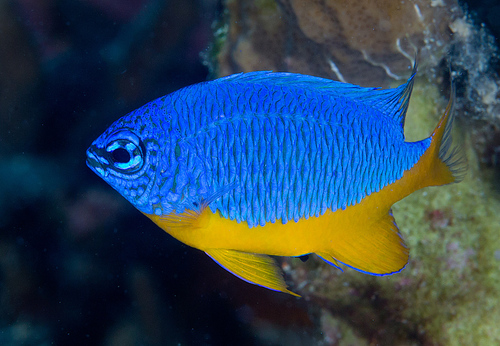
Azure Demoiselle
Chrysiptera hemicyanea
A sparkling gem of the Coral Triangle, the Azure Demoiselle lights up the reef with its electrifying blue and gold palette. This hardy little damselfish is a master of the 'hide-and-seek' lifestyle among branching corals.
Quick Identification
Size
Small reef fish reaching up to 7 cm (2.8 inches) in length.
Colors
Brilliant azure blue head and upper body; bright yellow lower belly, anal fin, and tail fin.
Key Features
- Electric blue upper body with contrasting yellow belly and tail
- Deeply forked caudal fin
- Small, oval-shaped body profile
- Associated with branching Acropora corals
When You’ll See Them
Geographic range
Where Does the Azure Demoiselle Live?
The Azure Demoiselle is native to the tropical heart of the Indo-West Pacific. It is most frequently encountered throughout the Indonesian archipelago, ranging from the Bird's Head Peninsula to the Solomon Islands and north into the Philippine seas. While its natural range is concentrated within the Coral Triangle, it is a globally recognized species due to its prominence in the marine aquarium hobby.
Basemap © OpenStreetMap contributors
Behavior
The Azure Demoiselle is a highly active and somewhat territorial species of damselfish. They are typically found in small groups or pairs, hovering just above branching corals where they can quickly retreat if a predator appears. Unlike some more nomadic reef fish, the Azure Demoiselle is a homebody, often spending its entire adult life within a few meters of a single coral head.
These fish exhibit a fascinating 'hop-and-hover' swimming pattern, darting into the water column to snatch zooplankton carried by the current. While they are generally peaceful toward other species, they can be surprisingly feisty when defending their preferred coral branches from other damselfish or small intruders. Their diurnal nature means they are strictly active during daylight hours, retreating deep into the coral skeleton at night to sleep.
EverydayEarth exclusive
Camera Tips
To capture the stunning neon hues of the Azure Demoiselle, camera placement is everything. Since these fish are 'coral-obligate' dwellers, you should aim your underwater camera housing directly at a healthy patch of branching coral, such as Acropora. Set the camera at a slight upward angle (about 30 degrees) to catch the sunlight filtering through the water's surface, which will make the iridescent blue scales shimmer brilliantly. Avoid placing the camera in high-surge areas; instead, look for sheltered lagoons where the water is clear and the fish feel comfortable hovering further away from their hiding spots.
Lighting is the biggest challenge for AI-powered underwater cameras. For the most accurate color representation, schedule your recording sessions between 10 AM and 2 PM. If your camera setup allows for external lighting, use a diffused wide-angle video light to fill in the shadows beneath the coral branches. This ensures the AI can distinguish the bright yellow belly of the Azure Demoiselle from the surrounding reef environment, which is crucial for automated species identification.
If you are monitoring a backyard reef tank or a coastal marine enclosure, try placing the camera near the point where the current is strongest, such as a pump output or a natural channel. The Azure Demoiselle will naturally orient itself facing into the current to catch food, providing you with perfect head-on shots. Use a high frame rate (at least 60fps) if possible, as these fish are known for their quick, darting movements that can result in motion blur on slower sensors. Finally, be patient—once you set the camera, give the fish at least 20 minutes to habituate to the new object before expecting them to return to their normal swimming patterns.
Frequently Asked Questions
Record Azure Demoiselle at your habitat
Connect a camera to start building your own species record — AI identifies every visitor automatically.