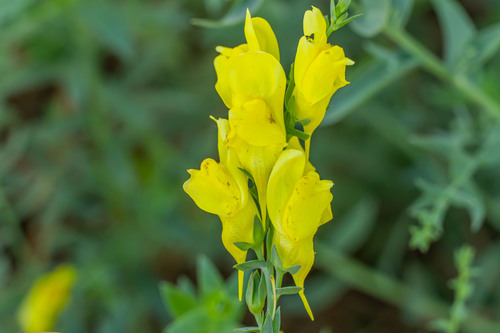
Balkan toadflax
Linaria dalmatica
A striking but opportunistic wildflower known for its brilliant yellow spikes and heart-shaped waxy leaves. Though beautiful to look at, this resilient perennial is a master of survival in even the harshest soils.
Quick Identification
Size
Stands 0.6 to 1.2 meters (2 to 4 feet) tall with a deep taproot reaching up to 1.5 meters (5 feet) deep.
Colors
Brilliant yellow flowers with a fuzzy orange center; heart-shaped, waxy blue-green foliage.
Key Features
- Bright yellow snapdragon-like flowers with long spurs
- Waxy, blue-green leaves that clasp the stem tightly
- Tall, upright stems that can reach four feet in height
- Dense clusters of flowers along the upper part of the stem.
When You’ll See Them
Geographic range
Where Does the Balkan toadflax Live?
Originally hailing from the sunny, rocky landscapes of southeastern Europe and western Asia, Balkan toadflax has significantly expanded its footprint across the globe. Today, it is most commonly found as a naturalized and often invasive species throughout the United States and Canada, particularly in the western regions and the Intermountain West. It thrives in temperate climates where it can dominate open fields, mountain foothills, and disturbed suburban corridors.
Basemap © OpenStreetMap contributors
Behavior
Balkan toadflax is a hardy, short-lived perennial that is most recognized for its aggressive growth and resilience. Unlike many backyard plants, it thrives in disturbed and poor soils, often colonizing roadsides, gravel pits, and overgrazed pastures. It spreads through two powerful mechanisms: a massive seed bank, where a single plant can produce half a million seeds per season, and an extensive creeping root system that allows it to form dense colonies or clones.
While it is often admired for its beautiful, snapdragon-like flowers, this species is highly competitive and can quickly out-muscle native vegetation in North American environments. It is particularly difficult to manage once established because its seeds can remain viable in the soil for up to ten years. In its invasive range, it lacks many of the natural predators found in its native Mediterranean home, allowing it to take over large swaths of land and reduce local biodiversity.
EverydayEarth exclusive
Camera Tips
Capturing the Balkan toadflax with an AI-powered or backyard camera requires a focus on its vertical structure and vibrant color. Because these plants can grow quite tall, position your camera on a tripod or mount it about 2-3 feet off the ground, angled slightly upward to capture the full length of the flowering spike. Since plants do not trigger motion sensors the same way animals do, utilize the 'Time-Lapse' mode on your camera to document the flowers opening during the morning hours or the swaying of the stems in the wind.
For the best visual results, look for the peak blooming period between late spring and mid-summer. The bright yellow flowers are highly reflective, so avoid direct midday sun which can wash out the details; instead, aim for the 'golden hour' shortly after sunrise or before sunset. This light will accentuate the waxy texture of the blue-green leaves and the deep orange center of the blossoms. If your camera has macro capabilities, get close—within 12 inches—to capture the intricate fuzzy 'beard' inside the flower throat.
Keep in mind that Balkan toadflax often attracts pollinators. Positioning your camera near a healthy cluster of flowers is a great way to catch secondary subjects like bumblebees, butterflies, and hummingbirds that are drawn to the nectar. Set your trigger sensitivity to high if you are hoping to catch these fast-moving visitors, and ensure your shutter speed is fast enough to freeze the motion of a hovering insect against the yellow backdrop.
Frequently Asked Questions
Record Balkan toadflax at your habitat
Connect a camera to start building your own species record — AI identifies every visitor automatically.