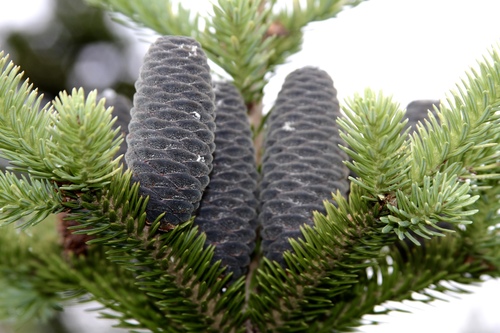
balsam fir
Abies balsamea
The aromatic icon of the North American wilderness, the Balsam Fir is famous for its perfect conical shape and silver-bottomed needles. It serves as a vital winter sanctuary for forest wildlife from Maine to Alberta.
Quick Identification
Size
Height 14–20 m (46–66 ft); trunk diameter up to 60 cm (24 in); crown spread 4–7 m (13–23 ft)
Colors
Dark green needles with two silvery-white bands on the underside; greyish-brown smooth bark with resin blisters
Key Features
- Narrow, conical spire-like crown
- Flat, blunt needles attached directly to the twig
- Smooth grey bark with raised resin-filled blisters
- Upright purple-tinted cones that disintegrate on the branch
When You’ll See Them
Geographic range
Where Does the balsam fir Live?
The Balsam Fir is a quintessential resident of the North American landscape, dominating the vast boreal forests of Canada and the northeastern United States. Its native range extends from the shores of Newfoundland and Labrador westward across all Canadian provinces to central Alberta, dipping southward into the Lake States and New England. In the southern reaches of its range, it is primarily a mountain dweller, clinging to the cool, misty peaks of the Appalachian Mountains as far south as West Virginia.
Basemap © OpenStreetMap contributors
Behavior
The Balsam Fir is a cornerstone of the North American boreal forest, characterized by its remarkable shade tolerance and symmetrical growth. Unlike many other conifers, it can survive for decades in the deep shade of a forest canopy, waiting for a gap to open up before surging upward. It is a slow-growing but persistent species that often forms dense thickets, providing essential thermal cover for larger mammals during harsh winters.
This tree is famously aromatic, producing a pleasant, resinous scent through its needles and the sticky sap found in blisters along its trunk. This resin serves as a primary defense mechanism against wood-boring insects and fungal pathogens. While it doesn't move, the tree interacts dynamically with its environment, serving as a primary host for various fungi and providing a stable platform for mosses and lichens to thrive in humid conditions.
EverydayEarth exclusive
Camera Tips
Capturing the Balsam Fir on camera requires a different strategy than mobile wildlife. To showcase the tree's iconic spire shape, place your camera at a distance of at least 15–20 feet, angled slightly upward. This 'hero shot' is best achieved during the 'golden hour'—the hour after sunrise or before sunset—when the low light catches the silvery undersides of the needles and the texture of the resinous bark.
For those interested in the wildlife that visits the tree, mount your camera directly onto the trunk of a neighboring tree at a height of 4–5 feet. Focus the lens on the Balsam Fir's lower branches. In winter, this species is a magnet for White-tailed Deer and Moose seeking shelter; setting your camera to 'Burst Mode' can capture these animals as they brush past the fragrant needles. In the spring, aim your camera toward the upper third of the tree to catch migratory warblers and chickadees that frequent the dense foliage for nesting.
Time-lapse is the secret weapon for tree photography. Set your AI camera to take one photo every hour for a full season. This will allow you to see the fascinating 'candle' growth of new light-green shoots in May and June, and the eventual disintegration of the upright cones in autumn. High-resolution settings are vital here to distinguish the flat needles from the similar-looking rounded needles of spruce trees.
Similar Species
Species that look similar or are commonly confused with balsam fir.
Fraser Fir
Nearly identical but found only at high elevations in the Southern Appalachians; its cones have visible bracts that stick out.
White Spruce
Needles are sharp and four-sided rather than flat; bark is scaly rather than smooth with blisters.
Eastern Hemlock
Needles are much shorter and attached to the twig by a tiny stalk; has much smaller, hanging cones.
Frequently Asked Questions
Record balsam fir at your habitat
Connect a camera to start building your own species record — AI identifies every visitor automatically.