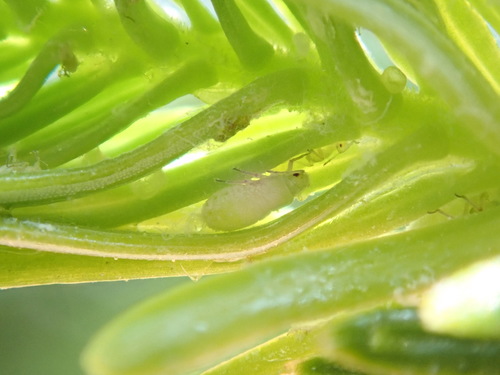
Balsam twig aphid
Mindarus pinicolus
Look closely at the tips of your fir trees to find this tiny, wool-covered architect of the forest. The Balsam twig aphid is famous for its early spring appearance and the dramatic curling it causes in new needles.
Quick Identification
Size
2–3 mm (0.08–0.12 inches) in length
Colors
Pale bluish-green body, often obscured by white, woolly waxy secretions; winged adults have dark markings on the thorax
Key Features
- Pale bluish-green body color
- Dense coating of white, woolly waxy filaments
- Causes distinct curling or 'shepherd's crook' twisting of new fir needles
- Produces large amounts of sticky honeydew
When You’ll See Them
Geographic range
Where Does the Balsam twig aphid Live?
This species is native to North America, primarily concentrated in the cool, temperate regions where its host trees thrive. Its core range spans across the Northeastern United States and much of Eastern and Central Canada, from the Maritime provinces westward through Ontario and Quebec. While most prevalent in wild balsam fir forests, it is also frequently encountered in commercial Christmas tree farms and residential gardens across the Great Lakes region and New England.
Basemap © OpenStreetMap contributors
Behavior
The Balsam twig aphid is a specialized feeder that emerges early in the spring, timed perfectly with the bud break of balsam and Fraser firs. As the tender new growth appears, these aphids congregate on the developing shoots, using their piercing-sucking mouthparts to drain sap from the soft needles. This feeding activity causes the characteristic 'shepherd’s crook' deformation, where needles curl inward and shoots twist, providing the aphids with a sheltered micro-environment.
These insects are highly social in their early life stages, often found in dense clusters surrounded by a 'wool' of white wax. This wax serves as protection against both predators and desiccation. They are prolific producers of honeydew, a sugary waste product that coats the tree's foliage. This sticky substance often attracts ants, which protect the aphids from ladybugs and lacewings in exchange for the sweet meal, and can eventually lead to the growth of black sooty mold on the needles.
EverydayEarth exclusive
Camera Tips
Capturing the Balsam twig aphid requires a macro lens or a specialized AI camera capable of focusing on extremely small subjects. Because these aphids are only a few millimeters long, you should position your camera just inches away from the terminal buds of balsam or Fraser firs. Look for the 'shepherd’s crook'—the distinctive curling of the new needles—as this is a sure sign that a colony is active inside the twisted growth.
Timing is critical for this species. Set your camera to monitor fir trees during the early spring 'bud break' when the new green shoots are first emerging. This is when the aphids are most active and visible before they disappear in the heat of mid-summer. Early morning light is ideal for photography, as it catches the white, waxy 'wool' these aphids produce, making them stand out against the dark green needles. High-resolution time-lapse settings can also be effective to show the gradual curling of the needles over several days.
Since these aphids don't move much, focus on their interactions with other insects. You are likely to capture ants 'farming' the aphids for honeydew or predators like ladybugs and lacewing larvae moving in for a meal. To get the best results, use a tripod or a stable mount to prevent wind-shake from ruining the macro focus. If your camera has a trigger for 'small motion,' set the sensitivity to high, or use a scheduled recording during peak daylight hours when activity is highest.
Similar Species
Species that look similar or are commonly confused with Balsam twig aphid.
Frequently Asked Questions
Record Balsam twig aphid at your habitat
Connect a camera to start building your own species record — AI identifies every visitor automatically.