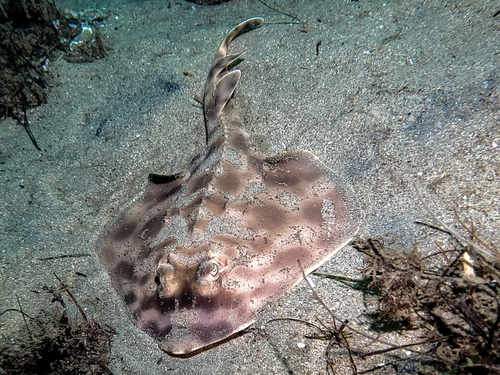
Banded Guitarfish
Zapteryx exasperata
Meet the 'Shark-Ray' of the Pacific. With its flat, guitar-shaped body and striking striped pattern, the Banded Guitarfish is one of the most unique residents of the California coastline.
Quick Identification
Size
Typically 60–90 cm (2–3 ft) in length, weighing up to 2.5 kg (5.5 lbs)
Colors
Light brown to olive-grey upper body with distinctive dark brown or black transverse bands; white or cream underside
Key Features
- Wedge-shaped snout and flattened disk-like body
- Dark, saddle-like bands across the back and tail
- Prickly texture due to small dermal denticles
- Two large dorsal fins located far back on the tail
When You’ll See Them
Geographic range
Where Does the Banded Guitarfish Live?
The Banded Guitarfish is a native resident of the Eastern Pacific Ocean. Its primary range spans from the central coast of California in the United States down through the entire Baja California peninsula and into the Gulf of California toward Mazatlan, Mexico. While it is most abundant in the warm-temperate waters of the Californias, it is a quintessential species of the Pacific continental shelf, rarely venturing into the deep open ocean.
Basemap © OpenStreetMap contributors
Behavior
The Banded Guitarfish is a master of camouflage and a patient hunter. Primarily a bottom-dweller, it spends much of its daylight hours partially buried in sandy or muddy substrates, with only its eyes and spiracles (breathing holes) exposed. This 'ambush' posture allows it to hide from predators while keeping a lookout for unsuspecting prey. Despite their shark-like appearance, they are remarkably docile and tend to remain motionless even when approached by divers, making them excellent subjects for underwater observation.
As nocturnal foragers, they become much more active after sunset. They move with a rhythmic, undulating motion, using their powerful tails more than their pectoral fins for propulsion, which is a trait that highlights their evolutionary link between sharks and rays. They are generally solitary creatures but can be found in higher concentrations in shallow bays during the breeding season. For humans, they pose no threat, as they lack venomous stingers or aggressive tendencies.
EverydayEarth exclusive
Camera Tips
To capture high-quality footage of a Banded Guitarfish, your camera must be positioned on the seafloor rather than suspended. If you are using a waterproof trail camera or a tethered underwater unit, look for 'edges' where rocky reefs meet sandy plains. These are natural highways for guitarfish as they move between hunting grounds. Aim the lens horizontally, just 5-10 inches off the bottom, to catch their unique low-profile silhouette as they glide by.
Because these fish are most active at night, ensure your camera has a strong infrared (IR) flash or high-quality low-light sensors. They are not easily spooked by artificial light, but a soft red light is often better for capturing natural hunting behavior without overexposing their pale underbellies. If you are in a legal area for it, placing a small perforated canister of mashed sardines or 'chum' just out of frame can encourage a guitarfish to linger in front of the lens while it investigates the scent.
Seasonality plays a big role in camera success. During the late summer months, these fish often move into very shallow water (less than 10 feet deep) to pup or mate. Setting up a camera in sheltered bays or near the mouths of estuaries during this time can yield spectacular results. Always ensure your camera housing is weighted or securely anchored to a fixed object, as surge and bottom currents can easily tumble a lightweight camera across the sand.
Similar Species
Species that look similar or are commonly confused with Banded Guitarfish.
Frequently Asked Questions
Record Banded Guitarfish at your habitat
Connect a camera to start building your own species record — AI identifies every visitor automatically.