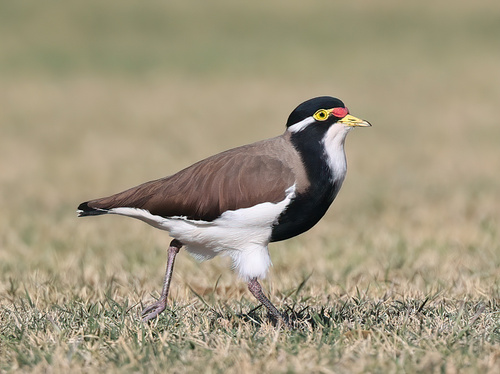
Banded Lapwing
Vanellus tricolor
A striking ground-dweller of the Australian plains, the Banded Lapwing is famous for its bold 'V' breast band and its fearless, nomadic spirit. Often heard before it is seen, this clever plover is a master of the open grassland.
Quick Identification
Size
25–29 cm (10–11.5 in) long; Wingspan 60–70 cm (24–28 in); Weight 140–200 g (5–7 oz)
Colors
Brown upperparts, white underparts with a prominent black 'V' band on the breast, black cap, white eye-stripe, and small red facial wattles.
Key Features
- Distinctive black breast band against a white chest
- Small red fleshy wattle located in front of each eye
- Prominent white stripe extending from behind the eye to the back of the head
- Yellow bill with a dark tip and long, dull-red legs
When You’ll See Them
Geographic range
Where Does the Banded Lapwing Live?
Native to the continent of Australia, the Banded Lapwing is widely distributed across the southern half of the country. It is most commonly found in the temperate and arid regions of South Australia, Western Australia, New South Wales, and Victoria, occasionally reaching as far north as the tropical grasslands during particularly dry seasons. This nomadic species is a true specialist of the open plains, avoiding heavily forested areas and the extreme tropical north.
Basemap © OpenStreetMap contributors
Behavior
Banded Lapwings are primarily terrestrial birds that prefer spending their time on the ground rather than in the air. They are often seen in small groups or 'parties,' moving across open ground with a distinctive 'run-stop-peck' motion. While they can be shy around humans, they are famously bold and aggressive when defending their ground nests, often performing 'broken-wing' displays to lead predators away or dive-bombing intruders with loud, piercing metallic cries.
These birds are highly social and communicative, frequently emitting a sharp 'chi-chi-chi' call that can be heard from a significant distance. Unlike many other shorebirds, they are well-adapted to arid environments and are known for their nomadic tendencies, frequently moving across the continent to follow localized rainfall in search of optimal foraging and breeding conditions. They remain active during both the day and night, particularly during moonlit evenings.
EverydayEarth exclusive
Camera Tips
To capture high-quality footage of the Banded Lapwing, camera placement is everything. Since these birds are strictly ground-dwellers that prefer short-grass environments, your camera should be mounted no more than 15 to 20 centimeters (6-8 inches) off the ground. Aim for a horizontal angle or a very slight downward tilt to ensure you capture their distinctive leg movements and the black breast markings. Positioning the camera on the edge of a flat, open patch of lawn or a fallow field is ideal, as they avoid tall vegetation where predators might hide.
Unlike forest birds, Banded Lapwings are easily spooked by new objects in wide-open spaces. If possible, camouflage your camera with local grasses or stones, but ensure the lens and PIR sensor remain completely unobstructed. Because they are active both day and night, ensure your camera has a fast trigger speed and a high-quality infrared flash. White feathers can easily blow out and look overexposed in night shots, so if your camera allows, adjust the flash strength to 'medium' for subjects at close range.
Banded Lapwings are not easily 'baited' with traditional birdseed, as they prefer live prey. However, they are highly attracted to recently mown grass or areas where the soil has been slightly disturbed, as this brings insects to the surface. If you have a large property, try setting your camera near a shallow water source or a 'soak' during dry spells, as these birds will visit regularly to drink and bathe. They are also known to follow livestock that stir up insects in the grass.
Keep your PIR sensitivity set to high. Banded Lapwings move in quick, erratic bursts and can traverse the frame in a second. Using a 'burst mode' for photos or a short video clip (10-15 seconds) is the best way to see their unique behaviors, like their 'foot-trembling' technique used to flush out underground invertebrates. If you catch them nesting, keep a respectful distance with the camera, as they are very sensitive to disturbance during the incubation period.
Similar Species
Species that look similar or are commonly confused with Banded Lapwing.
Frequently Asked Questions
Record Banded Lapwing at your habitat
Connect a camera to start building your own species record — AI identifies every visitor automatically.