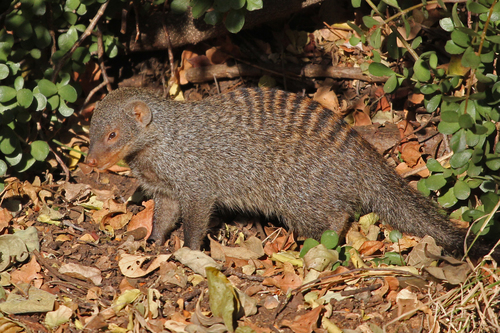
Banded Mongoose
Mungos mungo
The Banded Mongoose is Africa's most social small carnivore, famous for its zebra-like stripes and complex family life. Living in large, cooperative packs, these busy foragers are a delight to watch as they whistle and dig their way across the savanna.
Quick Identification
Size
Body length of 30-45 cm (12-18 in) with a 15-30 cm (6-12 in) tail; weight typically ranges from 1.5 to 2.5 kg (3.3-5.5 lbs).
Colors
Grizzled brownish-gray coat with 10-15 distinctive dark horizontal bands across the back from the midsection to the base of the tail.
Key Features
- Dark horizontal bands across the back
- Strong, curved claws for digging
- Small, rounded ears and a pointed snout
- Short, dark limbs and a tapered tail
When You’ll See Them
Geographic range
Where Does the Banded Mongoose Live?
The Banded Mongoose is native to the African continent, boasting an extensive range that stretches from the Sahel region southwards to the tip of South Africa. They are prominently found throughout East and Southern Africa, with healthy populations in countries such as Tanzania, Kenya, Botswana, and Zimbabwe. While they avoid the driest deserts of the Namib and the densest tropical rainforests of the Congo Basin, they thrive in almost any open or semi-open landscape across the sub-Saharan region.
Basemap © OpenStreetMap contributors
Behavior
Unlike most of their solitary mongoose cousins, Banded Mongooses are highly social animals that live in stable colonies of 10 to 40 individuals. These groups are remarkably egalitarian, with most adults breeding synchronously and the entire pack participating in the protection and feeding of the communal pups. They spend their nights huddled together in dens—often repurposed termite mounds or hollow logs—and emerge shortly after sunrise to begin their day.
When foraging, the group stays in close contact using a continuous stream of bird-like chirps and whistles to signal their location and warn of predators. They are active hunters, using their keen sense of smell to locate prey underground and their powerful claws to dig it out. While generally wary of humans, they can become quite habituated to presence in suburban areas or safari camps, though they should never be approached or fed.
EverydayEarth exclusive
Camera Tips
To capture the best footage of Banded Mongooses, place your camera very low to the ground—no more than 15 to 20 centimeters (6-8 inches) high. Because these animals are relatively small and stay close to the earth, a standard waist-high mount will often miss the detail of their facial expressions and their signature stripes. Angle the camera slightly upward if you are placing it near a known den site like an old termite mound.
These are social creatures, so wide-angle settings are preferable to capture the entire group as they move through an area. Look for 'scuff marks' in the dirt or small, conical holes which indicate where they have been digging for grubs. Placing your camera near these foraging sites or along the edges of brush piles where they seek cover will yield the most consistent results. Since they are diurnal, you won't need to rely heavily on infrared flash, but ensure your camera has a fast trigger speed to catch their quick, nervous movements.
While we don't recommend baiting with food, a shallow water dish or a small birdbath placed on the ground can be an irresistible draw during the dry season. Position your camera to face the water source from about 2 meters away. If you find a den site, avoid checking the camera too frequently, as excessive human scent can cause the colony to relocate their 'boma' or home base to a different site for safety.
Frequently Asked Questions
Record Banded Mongoose at your habitat
Connect a camera to start building your own species record — AI identifies every visitor automatically.