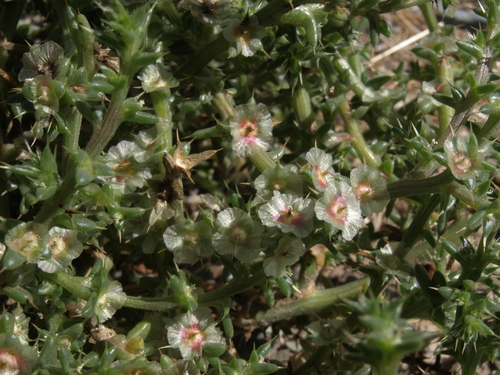
barbwire russian thistle
Salsola paulsenii
The barbwire Russian thistle is a rugged architect of the desert, famous for its transformation into the iconic tumbleweed. Its reddish, spine-tipped branches create a miniature fortress for wildlife in the harshest of environments.
Quick Identification
Size
Grows up to 1 meter (3.3 feet) in height and width, forming a rounded, brambly clump.
Colors
Reddish or purplish stems with yellow-green, fleshy leaves; flowers feature winged sepals that are whitish at the tips and pink at the base.
Key Features
- Intricately branched, prostrate to erect reddish stems
- Fleshy, needle-like leaves tipped with sharp spines
- Small flowers nestled in leaf axils with disk-like winged sepals
- Brittle base that breaks away to become a tumbleweed
When You’ll See Them
Geographic range
Where Does the barbwire russian thistle Live?
Native to the arid steppes and deserts of Eurasia, the barbwire Russian thistle has become a widespread resident of the American West. It is most commonly found across the Southwestern United States, particularly in the states of California, Nevada, Arizona, and Utah. While it originated in regions like Uzbekistan and Kazakhstan, it has successfully adapted to the high deserts and sandy basins of North America, where it thrives in the hot, dry climate.
Basemap © OpenStreetMap contributors
Behavior
The barbwire Russian thistle is a resilient annual herb known for its dramatic life cycle. During the spring and summer, it focuses on rapid growth, extending its reddish, wiry stems into a dense, protective thicket. It is a pioneer species, often the first to colonize disturbed or sandy soil where other plants struggle to survive. Its thorny structure serves as a natural deterrent against herbivores, though some desert specialists have adapted to navigate its spines.
The most famous behavior of this species occurs after it dies. In late autumn, the plant dries out and becomes extremely brittle. A specialized layer of cells at the base of the stem weakens, allowing the wind to snap the plant from its root system. This transforms the thistle into a 'tumbleweed,' rolling across the desert floor for miles. As it bounces, it shakes loose thousands of seeds, ensuring the next generation is spread across a wide geographic area.
EverydayEarth exclusive
Camera Tips
To capture the barbwire Russian thistle effectively, you should treat it as both a botanical subject and an action subject. During the growing season (mid-summer), set your camera on a low tripod to highlight the plant's unique 'skeleton.' The reddish stems provide a beautiful contrast against a blue sky or golden sand. Use a wide-angle lens to capture the full brambly structure, and consider a polarizing filter to manage the intense desert glare and make the stem colors pop.
For those interested in the iconic 'tumbleweed' phase, placement is key. Instead of aiming at a stationary plant, position your camera near natural catch-points like wire fences, cattle guards, or the edges of washes where windblown thistles accumulate. Use a high shutter speed or 'Sports' mode if you want to freeze the motion of a rolling plant, or a long exposure during a windy day to capture a ghost-like blur of motion across the landscape.
Because this plant often hosts small wildlife, it makes an excellent focus for backyard observation. Birds like sparrows and finches often perch on the inner branches for protection, and desert rodents may forage around the base for fallen seeds. Using a motion-trigger with high sensitivity can help you document these interactions. If your camera has a time-lapse feature, set it to take one photo every few days from June through November to create a stunning visual record of its transition from a green herb to a rolling tumbleweed.
Similar Species
Species that look similar or are commonly confused with barbwire russian thistle.
Frequently Asked Questions
Record barbwire russian thistle at your habitat
Connect a camera to start building your own species record — AI identifies every visitor automatically.