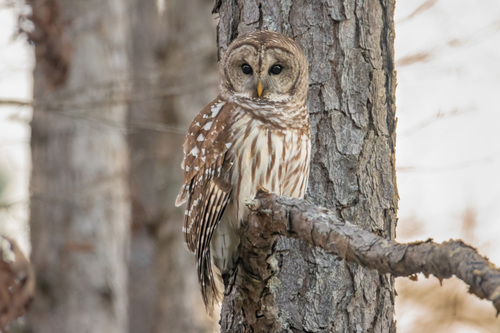
Barred Owl
Strix varia
With their soulful dark eyes and iconic 'Who cooks for you?' call, Barred Owls are the enchanting guardians of the forest. These large, earless owls are masters of the night but are bold enough to show themselves during the day.
Quick Identification
Size
Length: 43–50 cm (17–20 in); Wingspan: 99–110 cm (39–43 in); Weight: 470–1,050 g (1.0–2.3 lbs)
Colors
Mottled brown and white overall; horizontal brown bars on the neck and upper breast; vertical brown streaks on the white belly; dark brown, almost black eyes.
Key Features
- Large round head with no ear tufts
- Dark brown 'soulful' eyes (unlike the yellow eyes of most owls)
- Horizontal barring on chest transitioning to vertical streaks on the belly
- Pale facial disk with darker concentric rings
When You’ll See Them
Geographic range
Where Does the Barred Owl Live?
Native to the North American continent, the Barred Owl was historically a resident of the deep forests in the Eastern United States and Southern Canada. Over the last century, it has successfully expanded its territory westward across the Great Plains and into the Pacific Northwest, reaching as far south as Central Mexico. Today, it is a common sight and sound from the Atlantic coast to the evergreen forests of British Columbia and California.
Basemap © OpenStreetMap contributors
Behavior
The Barred Owl is perhaps most famous for its rhythmic 'Who cooks for you? Who cooks for you all?' call, which often echoes through the woods during the night and occasionally during the day. Unlike many other owl species, Barred Owls are surprisingly active during the daylight hours, particularly in cloudy weather or during the nesting season when hungry owlets demand constant feeding. They are highly territorial and will often respond to human imitations of their calls, sometimes flying in close to investigate the 'intruder.'
In social terms, these owls are generally solitary outside of the breeding season but maintain strong pair bonds. They are opportunistic sit-and-wait predators, perching quietly on a branch and scanning the ground for movement. While they generally avoid humans, they have become remarkably well-adapted to suburban living, provided there are enough mature trees for nesting and hunting.
EverydayEarth exclusive
Camera Tips
To capture high-quality footage of a Barred Owl, camera placement is everything. These owls love to hunt from 'perch points'—sturdy, horizontal branches about 10 to 20 feet off the ground that have a clear view of an open forest floor or a garden clearing. If you can identify a frequent hunting perch, mount your camera on an adjacent tree at the same height, or use a wide-angle lens if mounting lower and pointing upward. They are especially attracted to water; a large, stone-basin birdbath or a backyard pond is one of the best 'stages' for a Barred Owl, as they enjoy both drinking and bathing vigorously at twilight.
Because Barred Owls are highly vocal, ensure your camera's microphone is enabled and the sensitivity is turned up. Their vocalizations are distinct and will often trigger before the bird enters the frame. If you are using a trail camera, set the trigger speed to its fastest setting; these owls move with surprising silence and speed when they dive for prey. A high-quality infrared flash is essential for night captures, as their dark plumage can easily blend into the background of a low-quality black-and-white night shot.
During the winter months, Barred Owls are more likely to hunt during the day to conserve energy, making this the best time to capture full-color video. Avoid using 'lures' like recorded calls or artificial lights near their nesting sites, as this can cause significant stress. Instead, focus on natural attractants: maintaining a 'wild' corner of your yard with leaf litter and brush will attract the rodents that Barred Owls hunt, turning your backyard into a natural theater for their predatory displays.
Similar Species
Species that look similar or are commonly confused with Barred Owl.
Frequently Asked Questions
Record Barred Owl at your habitat
Connect a camera to start building your own species record — AI identifies every visitor automatically.