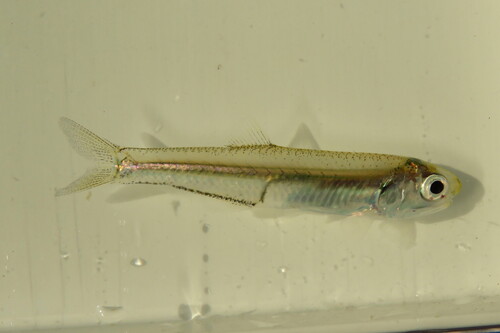
Bay Anchovy
Anchoa mitchilli
The unsung hero of the Atlantic coast, this shimmering, translucent fish forms the massive schools that fuel the entire marine ecosystem.
Quick Identification
Size
Typically 6 to 10 cm (2.4 to 4 inches) in length; maximum weight is approximately 5 to 8 grams (0.2 to 0.3 oz).
Colors
Translucent greenish-gray body with a distinct, bright silvery lateral stripe running from the gill to the tail.
Key Features
- Translucent, slender body
- Prominent silvery lateral stripe
- Large mouth extending well past the eye
- Deeply forked tail fin
When You’ll See Them
Geographic range
Where Does the Bay Anchovy Live?
The Bay Anchovy is native to the western Atlantic Ocean, where it is one of the most abundant vertebrate species. Its range spans from the coastal waters of Maine in the United States, stretching southward along the entire Atlantic seaboard to the Florida Keys. The population continues through the Gulf of Mexico and down to the Yucatan Peninsula, making it a ubiquitous presence in North American estuaries and shallow coastal shelf waters.
Basemap © OpenStreetMap contributors
Behavior
Bay Anchovies are highly social, schooling fish that spend their lives in constant motion. By forming massive, shimmering clouds of thousands of individuals, they use 'shoal defense' to confuse predators. They are a vital link in the coastal food web, serving as the primary energy source for popular game fish like Striped Bass, Bluefish, and Weakfish. Their movements are largely dictated by the tides and the seasonal temperature of the water.
These fish are also known for their incredible tolerance to varying salinity levels, allowing them to swim from the salty ocean into almost completely fresh river water. While they are generally shy and easily spooked by shadows or vibrations, they can sometimes be seen 'boiling' at the water's surface when being chased from below. They do not interact with humans directly but are a key indicator of a productive and healthy estuarine environment.
EverydayEarth exclusive
Camera Tips
To capture the elusive Bay Anchovy on an underwater backyard or dock camera, you need to focus on lighting and frame rates. Because these fish are nearly translucent and move very quickly, they can easily appear as mere blurs. Use a camera capable of recording at 60 frames per second (fps) or higher to freeze their movement. Positioning your camera in shallow, brackish water near a structure like a dock piling or a submerged rock will give the fish a point of reference to school around.
One of the most effective ways to attract Bay Anchovies to your lens is through 'light baiting' at night. Submerge a green or white LED light near your camera; this light attracts clouds of microscopic zooplankton, which in turn draws the anchovies in for a feeding frenzy. Angle your camera so it is looking slightly upward toward the surface to capture the silver flash of their lateral stripes reflecting the light.
Pay close attention to the tide cycles in your area. Bay Anchovies often follow the rising tide into shallow marsh creeks and retreat to deeper channels as the tide falls. Set your camera in a tidal pool or a narrow creek mouth during the incoming tide for the best chance at seeing large schools. In the summer months, be sure to clean your camera lens regularly, as the nutrient-rich water these fish inhabit causes rapid algae buildup that can ruin your footage.
Similar Species
Species that look similar or are commonly confused with Bay Anchovy.
Striped Anchovy
The Striped Anchovy is generally larger and has a much more brilliant, mirror-like silver stripe that is less translucent than the Bay Anchovy's.
Atlantic Silverside
Silversides have a smaller mouth that does not extend past the eye and possess two separate dorsal fins, while the Bay Anchovy has only one.
Frequently Asked Questions
Record Bay Anchovy at your habitat
Connect a camera to start building your own species record — AI identifies every visitor automatically.