Bendire's Thrasher
Toxostoma bendirei
A hidden gem of the American Southwest, Bendire's Thrasher is a master of the desert scrub. With its golden eyes and a song that rivals the finest mockingbirds, this elusive ground-forager is a prized find for any backyard wildlife enthusiast.
Quick Identification
Size
23–28 cm (9–11 in) in length; weight approximately 60–70 g (2.1–2.5 oz)
Colors
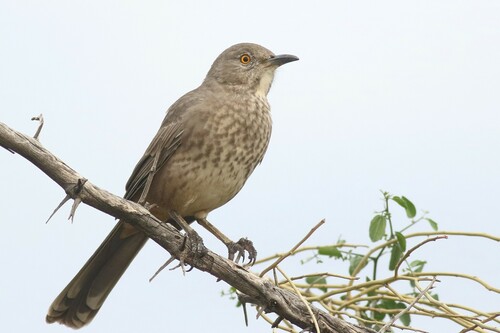
Pale grayish-brown upperparts with light triangular streaking on the breast; bright yellow to golden-orange eyes; bill is dark with a distinct pale flesh-colored base on the lower mandible
Key Features
- Relatively short and straight bill for a thrasher
- Bright yellow or golden-orange iris
- Faint, triangular spotting on the breast
- Pale base on the lower mandible
- White tips on the outer tail feathers
When You’ll See Them
Geographic range
Where Does the Bendire's Thrasher Live?
The Bendire's Thrasher is a specialist of the North American Southwest, found primarily in the arid regions of Arizona and New Mexico. Its native range extends northward into southern Utah and Nevada, and westward into the Mojave Desert of southeastern California. In Mexico, it is commonly found across the desert plains of Sonora and northern Chihuahua, where it thrives in landscapes dominated by scattered brush and cactus.
Basemap © OpenStreetMap contributors
Behavior
They are highly territorial and monogamous, often staying with the same partner within a well-defined patch of desert scrub. While they are less likely to visit traditional hanging bird feeders than other backyard birds, they are creatures of habit and will often follow a predictable circuit through their territory each day. Interactions with humans are rare, as they prefer the quiet solitude of open arid lands, but they can become accustomed to observers who remain still and respectful of their space.
EverydayEarth exclusive
Camera Tips
To capture the best footage of a Bendire’s Thrasher, set your AI-powered camera low to the ground, ideally about 12 to 18 inches high. These birds spend the vast majority of their time running across the desert floor or digging in the dirt, so a camera aimed at a clear patch of sandy soil near the base of a mesquite or cholla cactus is far more likely to trigger than one mounted high on a post. Ensure the camera is positioned to catch the side profile of the bird, which helps the AI distinguish its straighter bill from other thrasher species.
Because they are desert dwellers, water is an incredible lure. A ground-level birdbath or a simple dripping water feature will draw Bendire's Thrashers in, especially during the dry heat of mid-summer. If you are using bait to encourage a visit, avoid standard birdseed; instead, try scattering mealworms or suet crumbles directly on the ground in a shady, protected area. They are naturally curious about disturbed soil, so lightly raking a small patch of earth can sometimes attract them to investigate for exposed insects.
Since this species is quite fast-moving, use a high shutter speed or a high-frame-rate video setting to avoid motion blur during their energetic digging. Early morning light provides the best illumination for their golden eyes, while the soft light of dusk helps reveal the subtle triangular streaks on their breast. Avoid checking the camera during the middle of the day if you know they are nesting nearby, as they are sensitive to disturbances in their immediate territory.
Similar Species
Species that look similar or are commonly confused with Bendire's Thrasher.
Frequently Asked Questions
Record Bendire's Thrasher at your habitat
Connect a camera to start building your own species record — AI identifies every visitor automatically.