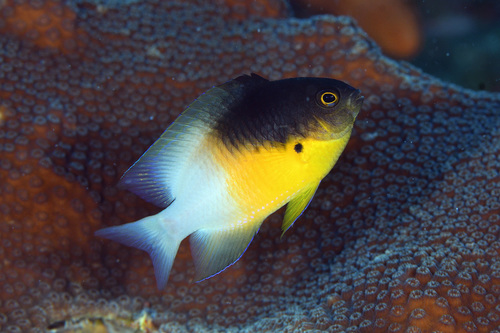
Bicolor Damselfish
Stegastes partitus
The Bicolor Damselfish is the tiny, two-toned 'gardener' of the Caribbean reefs. While small in stature, this feisty fish is famous for its bold personality and its habit of fiercely defending its personal patch of coral.
Quick Identification
Size
7-10 cm (2.7-4 inches) in length
Colors
Dark brownish-black front half, pale yellow to white back half; some individuals may show a yellowish wash on the pectoral fins
Key Features
- Distinct 'bicolor' split with dark head and light tail
- Deep, oval-shaped body profile
- Single continuous dorsal fin
- Small mouth positioned for nipping algae
When You’ll See Them
Sightings on EverydayEarth
Jul 30, 2026
A vibrant coral reef scene featuring a large Queen Angelfish swimming across the lower foreground. The water is teeming with life; several bright blue Chromis hover in the water column while Bicolor Damselfish and juvenile Bluehead Wrasse move amongst the large sea fans and brain corals. The reef is active with various species navigating the surge-swept gorgonians under bright sunlight.
Jul 27, 2026
The footage captures a transition from the ocean surface under a late afternoon sky to the underwater world of a coral reef. Once submerged, the scene is active with reef fish. A Bicolor Damselfish is seen hovering near the center-right, while several Bluehead Wrasse in their initial phase swim rapidly among the purple sea fans and coral heads. The water is clear, showing the detailed textures of the reef floor.
Jul 26, 2026
A busy scene on a Caribbean reef. Several yellow Bluehead Wrasses dart around large sea fans and coral heads, while a terminal phase male wrasse with its characteristic blue head and green body swims through the background. A Bicolor Damselfish is seen hovering near the central sea fan, and a larger Stoplight Parrotfish in its initial phase moves across the lower-left corner of the frame.
Jul 26, 2026
On a vibrant coral reef, several small fish dart among swaying sea fans and sea whips. A Bicolor Damselfish is prominently visible in the mid-ground, hovering near the coral structures, while small Blue Chromis and an Atlantic Sergeant Major swim in the clear blue water above the reef wall. The scene is illuminated by sunlight filtering through the ocean surface.
Jul 26, 2026
A vibrant reef scene features several fish active around large gorgonian sea fans. Two brilliant Blue Chromis swim through the center of the frame, hovering in the water column to feed on plankton. Meanwhile, a Bicolor Damselfish remains near the reef substrate on the right side of the frame, and a yellow phase wrasse is briefly visible darting through the coral on the left.
Jul 26, 2026
A vibrant reef scene is filled with activity. A Schoolmaster snapper swims slowly near the bottom among sea fans and coral. In the water column above, schools of Blue Chromis and yellow Bluehead Wrasse dart around. A Bicolor Damselfish is visible near the reef structure in the lower left, while a Sergeant Major passes through the upper right of the frame.
Geographic range
Where Does the Bicolor Damselfish Live?
The Bicolor Damselfish is a quintessential species of the Western Atlantic's warm waters. Its core range encompasses the entire Caribbean Sea and the Gulf of Mexico, extending northward to the Florida Keys and throughout the Bahamas. It is also commonly found along the Atlantic coasts of Central and South America, stretching from Belize down to the northern shores of Venezuela.
Basemap © OpenStreetMap contributors
Behavior
The Bicolor Damselfish is a small but incredibly feisty resident of the reef. They are best known for their intense territoriality; each adult maintains a small patch of the reef as its private 'garden' where it cultivates preferred species of algae. They are fiercely protective of these areas, often charging at fish many times their size to drive them away.
Socially, they form loose colonies, but within those colonies, every individual has its own strictly defined borders. During the breeding season, males become even more active, performing a 'dip' swimming motion to attract females to their nesting site. Interestingly, these fish are also vocal, producing audible chirping or 'pop' sounds during courtship and territorial disputes by grinding their pharyngeal teeth.
EverydayEarth exclusive
Camera Tips
Capturing the Bicolor Damselfish requires a specialized underwater camera setup. Because these fish are small and stay close to the reef structure, you should position your camera on a weighted tripod or a fixed mount near a 'damselfish garden'—a patch of reef that looks cleaner or has more lush algae than the surrounding rock. Look for the fish’s 'perch,' usually a prominent coral head or rock where it sits to survey its territory.
To get the best color, use a camera with a red filter if you are deeper than 5 meters, or better yet, use a dedicated underwater video light. The Bicolor Damselfish’s dark front and light back can create exposure challenges; try to set your camera to a spot-metering mode if possible, or underexpose slightly to ensure the white tail isn't 'blown out' in bright tropical sunlight. Since these fish are constantly moving, a high frame rate (60fps or higher) is essential for capturing their quick territorial dashes.
Because traditional motion sensors often fail underwater due to floating debris (marine snow) and light refraction, the best strategy is to use a time-lapse mode. Set your camera to take a photo every 2-5 seconds or record short 30-second clips every few minutes. If you are using a GoPro or similar action camera, ensure you have a large battery pack or a waterproof external power source to allow the camera to run for several hours during the peak daylight when they are most active.
Similar Species
Species that look similar or are commonly confused with Bicolor Damselfish.
Frequently Asked Questions
Record Bicolor Damselfish at your habitat
Connect a camera to start building your own species record — AI identifies every visitor automatically.