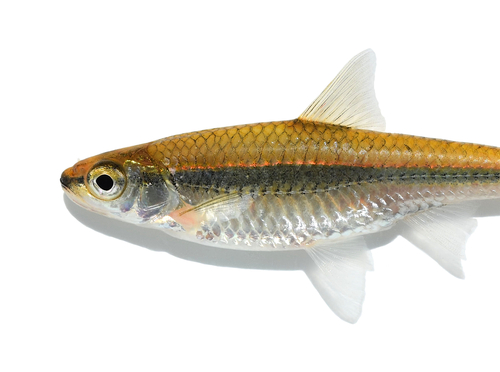
Bigeye Shiner
Miniellus boops
A striking, large-eyed minnow that serves as a living thermometer for stream health. These shimmering silver residents are the masters of clear, quiet upland pools.
Quick Identification
Size
Maximum total length of 80 mm (3.1 in), typically averaging 50–65 mm (2–2.5 in).
Colors
Bright silvery body with a prominent dark, dusky lateral stripe running from the snout to the tail. Scales on the upper back often have dark outlines, creating a faint diamond pattern.
Key Features
- Extraordinarily large eyes occupying nearly 1/3 of the head length
- Prominent dark lateral line extending through the eye to the tip of the snout
- Slender, streamlined silvery body
- Terminal mouth angled slightly upward
When You’ll See Them
Geographic range
Where Does the Bigeye Shiner Live?
The Bigeye Shiner is a native North American species primarily concentrated within the middle Mississippi River basin. Its range extends from the Ozark Highlands in Missouri and Arkansas, stretching eastward through the Ohio River valley into parts of Illinois, Indiana, and Ohio, and south into the Tennessee River system. While once more widespread, its distribution is now patchier due to sensitivity to water quality changes.
Basemap © OpenStreetMap contributors
Behavior
The Bigeye Shiner is a social, schooling fish that spends most of its time in the mid-water levels of quiet, clear pools within upland streams. Because they rely heavily on their oversized eyes to locate prey, they are rarely found in turbid or muddy water. They are known as an indicator species; their presence usually signals a healthy, low-silt aquatic environment.
During the day, schools can be seen hovering near submerged cover like logs or boulders, occasionally darting to the surface to snatch a falling insect. Unlike some more aggressive minnows, the Bigeye Shiner is relatively peaceful and maintains a tight-knit group structure for protection against larger predatory fish.
EverydayEarth exclusive
Camera Tips
Capturing the Bigeye Shiner requires an underwater setup, as their silvery bodies and the water's surface glare make them difficult to see from above. Use a waterproof action camera or a dedicated underwater trail camera. For the best results, secure your camera to a weighted base (like a diving weight or a flat rock) and place it on the floor of a quiet, clear pool downstream from a small riffle. The riffle provides a steady stream of food that will draw the fish into the camera's field of view.
Lighting is critical for these fish. Position your camera facing away from the direct sun to avoid harsh reflections off their metallic scales. Mid-morning or early afternoon provides the best light penetration into the water column. If you are using a backyard creek, look for areas with overhanging trees; the Bigeye Shiner loves to hover under cover waiting for insects to fall, which provides a natural 'stage' for your shots.
Because these fish are sensitive to movement, avoid checking the camera frequently. Let it sit for several hours to allow the school to become comfortable with the new object in their environment. If you want to encourage them to linger, you can use a small mesh bag filled with crushed insects or brine shrimp weighted down just in front of the lens. Use a high frame rate (60fps or higher) to capture their quick, darting movements with clarity.
Similar Species
Species that look similar or are commonly confused with Bigeye Shiner.
Frequently Asked Questions
Record Bigeye Shiner at your habitat
Connect a camera to start building your own species record — AI identifies every visitor automatically.