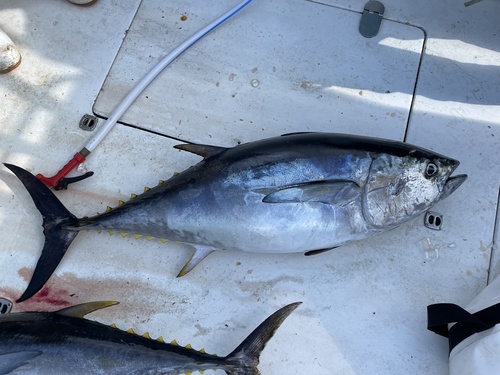
Bigeye Tuna
Thunnus obesus
A deep-diving titan of the open ocean, the Bigeye Tuna is a marvel of biological engineering. With its massive eyes and heat-regulating body, it thrives in the dark, cold depths where other predators cannot follow.
Quick Identification
Size
Up to 2.5 meters (8.2 feet) in length and weighing up to 210 kg (460 lbs)
Colors
Metallic dark blue on the back, transitioning to a silvery-white belly; a subtle iridescent blue band runs along the sides in live specimens
Key Features
- Extraordinarily large eyes adapted for low-light hunting
- Pectoral fins reach past the base of the second dorsal fin
- Deep, streamlined, almost teardrop-shaped body
- Yellowish dorsal and anal fins with small dark finlets
When You’ll See Them
Geographic range
Where Does the Bigeye Tuna Live?
Native to the tropical and subtropical waters of the Atlantic, Indian, and Pacific Oceans, the Bigeye Tuna is a truly global citizen of the high seas. Its range extends from the shores of the Americas across the vast expanse of Oceania to the coasts of Africa and Southeast Asia. While they avoid the frigid polar regions and the enclosed Mediterranean Sea, they are frequently found in the productive upwelling zones of the eastern Pacific and Atlantic oceans.
Basemap © OpenStreetMap contributors
Behavior
The Bigeye Tuna is a master of the deep-water vertical migration. Unlike many of its surface-dwelling relatives, this species possesses a specialized vascular system that allows it to maintain a body temperature higher than the surrounding water. This physiological edge enables it to dive into the cold, oxygen-poor depths of the mesopelagic zone (down to 500 meters or more) during the day to hunt, then return to warmer surface waters at night to recover and regulate its metabolism.
Socially, Bigeye Tuna are known to school by size, often associating with other tuna species like Yellowfin or Skipjack. They are particularly drawn to floating objects, such as logs or man-made Fish Aggregating Devices (FADs), a behavior that makes them highly susceptible to commercial fishing. While they are primarily solitary or small-group hunters in their adult phase, they remain highly migratory, traveling thousands of miles across oceanic basins in search of optimal feeding and spawning grounds.
EverydayEarth exclusive
Camera Tips
Capturing the Bigeye Tuna on camera is a challenge that requires moving beyond the backyard and into the blue water. For those lucky enough to live on the coast or own a vessel, an underwater 'drop camera' or a Baited Remote Underwater Video (BRUV) system is the most effective tool. Since Bigeye Tuna are attracted to structure, mounting your camera to a floating buoy or beneath a drifting platform in deep offshore waters will significantly increase your chances of a sighting. Ensure your housing is rated for at least 60 meters, though much deeper is required if you want to capture their unique daytime deep-diving behavior.
Lighting is critical for oceanic photography. Because the Bigeye Tuna often stays deep during the day, natural light will be filtered out, leaving your footage with a heavy blue or green cast. Using high-powered external strobes or video lights is essential to reveal the metallic luster of their scales and the yellow of their finlets. If you are filming near the surface at night, use red-spectrum lights to avoid startling the fish, as their large eyes are incredibly sensitive to bright white flashes in the darkness.
For the best action shots, set your camera to a high frame rate (at least 60fps, but 120fps is better) to account for their incredible swimming speed. Bigeye can burst at speeds over 40 mph, which can result in motion blur on standard settings. Use a wide-angle lens to capture the full scale of a schooling event, and consider using a polarized filter if your camera is mounted just below the surface to cut through the glare of the sun reflecting off the water's 'ceiling'.
Similar Species
Species that look similar or are commonly confused with Bigeye Tuna.
Frequently Asked Questions
Record Bigeye Tuna at your habitat
Connect a camera to start building your own species record — AI identifies every visitor automatically.