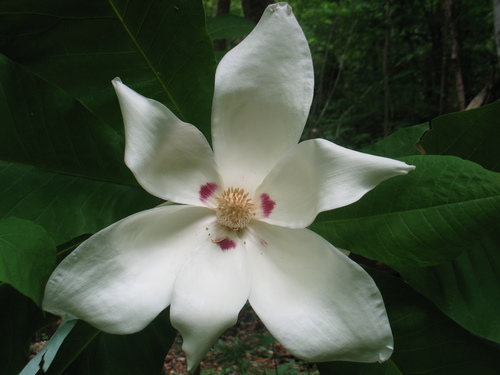
bigleaf magnolia
Magnolia macrophylla
The bigleaf magnolia is a prehistoric giant hiding in the American South, boasting the largest leaves and flowers of any native North American tree. Its foot-wide blossoms and three-foot leaves transform any backyard into a tropical, ancient wonderland.
Quick Identification
Size
Tree height of 10–15 meters (30–50 feet); leaves 60–90 cm (24–36 inches) long; flowers 20–30 cm (8–12 inches) in diameter.
Colors
Bright green upper leaf surfaces with distinctive silvery-grey, velvety undersides; flowers are creamy white with purple-rose staining at the base of the inner petals.
Key Features
- Largest simple leaves of any tree native to North America
- Massive, fragrant white flowers up to a foot wide
- Heart-shaped or 'eared' leaf bases (auriculate)
- Large, rose-red cone-like fruit aggregates in late summer
- Smooth, thin, light grey bark
When You’ll See Them
Geographic range
Where Does the bigleaf magnolia Live?
The bigleaf magnolia is a signature species of the Southeastern United States, though its distribution is famously patchy and localized. It is primarily found in the Cumberland Plateau, the Gulf Coastal Plain, and parts of the Piedmont, with significant populations in Alabama, Mississippi, and Kentucky. While it is native to the North American continent, it is rarely found in dense stands, instead appearing as a spectacular surprise in rich, moist pockets of the American South.
Basemap © OpenStreetMap contributors
Behavior
The bigleaf magnolia is a deciduous powerhouse that functions as a living relic of ancient North American forests. Unlike many modern flowering trees that produce numerous small blossoms, this species focuses its energy into a few gargantuan flowers that open in late spring. It relies on a primitive pollination system, primarily attracting various species of flower beetles that are lured into the massive, bowl-shaped blooms by a sweet, heavy scent and specialized heat-producing tissues.
In the landscape, this tree is relatively slow-growing and tends to be somewhat reclusive, often found in the deep, wind-sheltered understory of larger hardwoods. While it does not move like an animal, it 'behaves' by dramatically shedding its massive leaves in autumn, which create a thick, protective mulch layer that suppresses competing vegetation. In suburban environments, it acts as a significant provider of shade and a unique structural nesting site for birds that prefer dense, large-leafed cover.
EverydayEarth exclusive
Camera Tips
Capturing the bigleaf magnolia on a trail camera requires a shift from motion-triggering to time-lapse photography. Because the 'action'—the opening of the massive bloom—happens slowly over 24 to 48 hours, set your camera to take a photo every 10 to 15 minutes. Mount the camera on a sturdy tripod or an adjacent branch approximately 6 to 10 feet off the ground, aiming slightly downward into a developing flower bud. This will allow you to witness the dramatic 'beetle trap' mechanism where the flower opens, traps pollinators, and then releases them the next day.
Wind is your biggest enemy when photographing this species. The enormous leaves act like sails, and even a light breeze can cause a standard motion-activated camera to trigger hundreds of times an hour. To avoid a dead battery and a full SD card, lower the PIR (Passive Infrared) sensitivity to the 'Low' setting or disable motion entirely in favor of the time-lapse mode. If you are specifically hunting for the pollinators, position the camera within 3 feet of the bloom and use a high-speed trigger setting to catch beetles and bees as they land.
For the best visual results, pay attention to the light. The bigleaf magnolia’s most beautiful feature is the silvery-white underside of its leaves. Position your camera to the south of the tree so that the afternoon sun 'backlights' the foliage, making the leaves appear to glow on camera. In the autumn, redirect your camera toward the bright pink, cone-like fruits; these are highly attractive to squirrels and large birds, providing a great opportunity to capture foraging behavior against the backdrop of the tree's massive, drying leaves.
Similar Species
Species that look similar or are commonly confused with bigleaf magnolia.
Frequently Asked Questions
Record bigleaf magnolia at your habitat
Connect a camera to start building your own species record — AI identifies every visitor automatically.