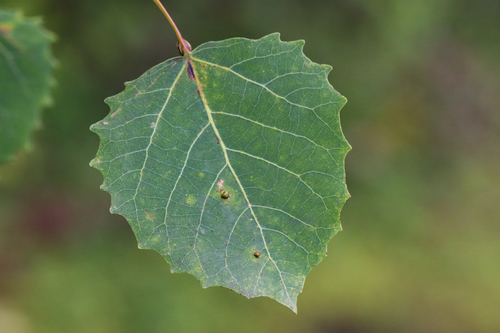
bigtooth aspen
Populus grandidentata
A fast-growing pioneer of the North American woods, the Bigtooth Aspen is famous for its fluttering golden leaves and its role as a vital food source for grouse, deer, and beavers.
Quick Identification
Size
Height of 18-24 meters (60-80 feet) with a trunk diameter of 30-60 centimeters (1-2 feet)
Colors
Smooth greenish-white to olive-gray bark on young trees; dark gray, deeply furrowed bark at the base of mature trees; foliage is dusty green in summer and brilliant gold in autumn.
Key Features
- Coarsely toothed leaf margins with 5-15 large, curved teeth per side
- Flattened leaf stalks (petioles) that allow leaves to tremble in the breeze
- Smooth, olive-green bark that darkens and fissures with age
- Clonal root systems that produce groves of genetically identical trees
- Distinctive fuzzy, caterpillar-like catkins appearing in early spring
When You’ll See Them
Geographic range
Where Does the bigtooth aspen Live?
The Bigtooth Aspen is a hardy native of North America, primarily centered in the northeastern United States and southeastern Canada. Its core range stretches from the Great Lakes region and Minnesota eastward to the Atlantic coast of New England and the Maritime Provinces. While it is most abundant in the north, it also follows the cool climate of the Appalachian Mountains southward into parts of North Carolina and Tennessee.
Basemap © OpenStreetMap contributors
Behavior
The Bigtooth Aspen is a fast-growing, relatively short-lived pioneer species that plays a critical role in forest regeneration. It is famous for its clonal behavior; a single seed can establish a root system that sends up hundreds of genetically identical "suckers," eventually creating a massive grove that is technically a single organism. These colonies are often the first to reclaim land after a fire, logging, or clear-cutting, providing immediate cover for wildlife.
Ecologically, this tree is a "nursery" species. Its light-filtering canopy allows enough sun to reach the forest floor for shade-tolerant hardwoods like maples and oaks to grow beneath it. Over time, these slower-growing trees eventually overtake the aspen. In the backyard setting, the Bigtooth Aspen is known for the relaxing, rustling sound its leaves make, caused by the unique flattened shape of the leaf stalks which catch even the slightest movement of air.
EverydayEarth exclusive
Camera Tips
When using an AI-powered camera to capture wildlife around a Bigtooth Aspen, focus on the "browse zone." This tree is a high-traffic cafeteria for local fauna. Position your camera approximately 3 to 4 feet off the ground, angled toward a cluster of young aspen suckers. White-tailed deer and moose are highly attracted to the tender, nutrient-rich twigs and bark of young Bigtooth Aspens, especially in late winter and early spring.
Don't just look at the ground; the Bigtooth Aspen's canopy is a hotspot for bird activity. If your camera is mobile or can be mounted higher, point it toward the branches in early spring (April or May) when the catkins appear. These fuzzy flowers are a primary food source for Ruffed Grouse. If you see a grouse drumming nearby, there is a high likelihood they are utilizing an aspen stand for both cover and forage.
For those interested in smaller mammals, place your camera near the base of a mature tree. Porcupines and beavers are famous for their love of aspen bark. If you notice horizontal tooth marks or stripped bark near the base, you have found a perfect trail camera bottleneck. Set your trigger sensitivity to high, as these animals can be slow-moving but blend in perfectly with the gray, furrowed bark.
Finally, leverage the "trembling" nature of the leaves for motion-capture tests. Because the Bigtooth Aspen's leaves move in even the lightest breeze, they are excellent for calibrating your AI camera's false-trigger filters. During the autumn, the vibrant yellow leaves provide a stunning high-contrast backdrop for any animal passing by, making for professional-grade backyard wildlife photography.
Similar Species
Species that look similar or are commonly confused with bigtooth aspen.
Quaking Aspen
Has much smaller, finer teeth on the leaf margins and bark that remains smoother and whiter for longer.
Paper Birch
The bark peels away in thin, papery sheets, unlike the Bigtooth Aspen bark which eventually becomes deeply furrowed and dark.
Balsam Poplar
Features sticky, resinous buds that smell like balsam and leaves that are more egg-shaped and finely toothed.
Frequently Asked Questions
Record bigtooth aspen at your habitat
Connect a camera to start building your own species record — AI identifies every visitor automatically.